
When Your Vacuum Is Watching You: The Hidden Dangers Of The Smart-Home Explosion
 By PNW Staff February 28, 2026
Share this article:
The promise of the modern smart home sounds irresistible: lights that anticipate your mood, thermostats that learn your habits, cameras that guard your family, and robots that quietly clean your floors while you sleep. But beneath that glossy vision lies a growing and deeply unsettling reality--our homes, once our most private sanctuaries, are quietly transforming into networks of microphones, cameras, sensors, and cloud connections that can be accessed, exploited, or exposed in ways most people barely understand.
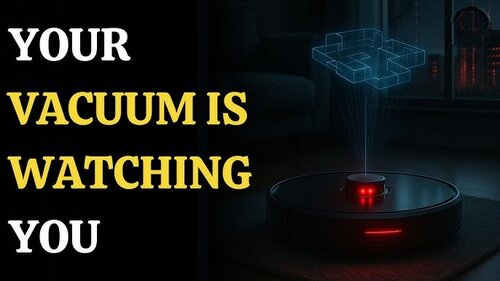
A recent incident involving a software engineer illustrates just how fragile this digital fortress really is. While experimenting with his own robot vacuum, Sammy Azdoufal reportedly used an AI coding assistant to reverse-engineer how the device communicated with the servers of DJI. What he discovered should alarm anyone with a smart device in their living room.
The same credentials that allowed him to access his own vacuum also opened the door to live camera feeds, audio recordings, maps, and system data from nearly 7,000 other machines spread across 24 countries. In other words, a single security flaw effectively created a global surveillance network inside people's homes--one that neither they nor the manufacturer realized existed.
The company told Popular Science the issue has since been fixed. But the deeper concern remains unresolved: if one engineer can stumble into that level of access by accident, what could a malicious actor accomplish intentionally?
Cybersecurity experts have warned for years that internet-connected household devices are prime targets for hackers, spies, and data brokers. Unlike laptops or smartphones, many smart appliances are built with convenience--not security--as the primary design goal. They often ship with weak protections, rarely receive updates, and rely heavily on remote servers. Yet they operate in the most intimate corners of daily life: bedrooms, kitchens, children's playrooms.
And the risks are not hypothetical. Earlier this month, users of Ring cameras flooded social media after a company advertisement promoting a pet-finding feature was interpreted by critics as hinting at broader neighborhood surveillance capabilities. Around the same time, reports that Google was able to retrieve footage from a smart doorbell camera to assist in a criminal investigation--even after the owner believed it had been deleted--sparked renewed debate about who truly controls the data collected inside private homes.
To be clear, law enforcement access to digital evidence can help solve crimes. But the controversy highlights a troubling truth: many consumers don't fully grasp where their data lives, how long it is stored, or who can access it. The convenience of cloud-connected devices often comes at the cost of surrendering control.
Lawmakers in the United States have repeatedly raised alarms about potential national-security risks tied to foreign-manufactured smart technology, particularly from companies based in China. While concrete public evidence is often limited or classified, bipartisan concern has still been strong enough to justify restrictions or bans on certain products. Critics argue these warnings can be politically motivated; supporters counter that the stakes--mass surveillance, espionage, infrastructure vulnerabilities--are simply too high to ignore.
What makes the situation even more concerning is the direction the market is heading. According to Parks Associates, as far back as 2020, 54 million American households already had at least one smart home device installed. Surveys consistently show that once consumers adopt one, they tend to add more. Smart speakers lead to smart locks. Smart locks lead to cameras. Cameras lead to robot assistants. The ecosystem expands until a home becomes less a private dwelling and more a fully instrumented data environment.
Ironically, the very features that make smart devices attractive also make them dangerous. Remote access means convenience--but also vulnerability. Voice control means ease--but also constant listening. AI automation means efficiency--but also data collection on a scale few users comprehend. Each new device is another door into the home network, another possible exploit point, another stream of personal information leaving the house and traveling who knows where.
The rise of AI coding assistants adds yet another layer of risk. These tools dramatically lower the technical barrier required to discover or exploit software flaws. Tasks that once required expert-level hacking knowledge can now be attempted by hobbyists--or criminals--with minimal experience. That democratization of capability may accelerate innovation, but it also accelerates vulnerability.
We are entering an era in which the average home could soon contain dozens of internet-connected sensors, each quietly transmitting data about daily routines, conversations, movements, and habits. In such a world, the question is no longer whether breaches will occur, but how often--and how severe--they will be.
The smart-home revolution is not inherently evil. Properly secured technology can genuinely improve safety, efficiency, and quality of life. But the current trajectory suggests society is racing ahead with adoption while lagging behind in safeguards, regulation, and consumer education.
Homes were once considered castles--places where privacy was assumed, not negotiated. Today, that assumption is dissolving into terms-of-service agreements and firmware updates. The real danger is not just that hackers might someday spy on us through our appliances. It is that we may become so accustomed to being observed that we stop noticing--or caring--at all.
And when that happens, the loss won't just be technical. It will be cultural, psychological, and profoundly human.