
The Oil War Has Begun: U.S. And Iran Target Energy Lifelines
 By PNW Staff March 09, 2026
Share this article:
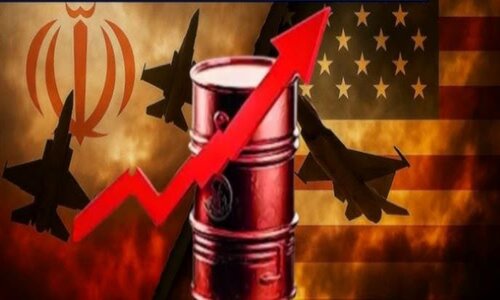
War has many fronts—land, air, sea, and cyberspace. But in the past 72 hours, the conflict between the United States and Iran appears to have opened a new and potentially more dangerous front: oil itself.
What began primarily as strikes on military bases, missile facilities, and command centers has shifted dramatically toward energy infrastructure. Oil depots, refineries, tanker routes, and export hubs are now being targeted across the Middle East. The message from both sides is clear: if you cannot defeat your enemy quickly on the battlefield, you can still damage them—and the world—through the price of energy.
The result is a rapidly escalating “oil for oil” war, where each side seeks to disrupt the other’s energy lifeline.
The Fires Over Tehran
One of the most striking images of the war so far came this week when massive flames lit the night sky over Tehran after strikes hit major fuel storage facilities. Witnesses described enormous columns of fire and smoke rising from the city’s oil depots after multiple storage tanks and fuel transfer facilities were hit.
These depots were reportedly tied to Iran’s military fuel supply network, but the symbolism was unmistakable: Iran’s energy backbone had been placed directly in the crosshairs.
It marked a turning point in the war.
Iran Strikes Back at the Oil Network
Iran did not take long to retaliate—and it did so in a way designed to send shockwaves through global markets.
Rather than focusing solely on U.S. forces, Iranian attacks have increasingly targeted the broader energy network of American allies across the region.
In the past week alone, at least five major oil-related incidents have highlighted this new strategy:
Drone attack on the Ras Tanura refinery in Saudi Arabia, one of the kingdom’s largest oil processing hubs. Even limited damage forced temporary shutdowns and rerouting of exports.
Missile and drone strikes across Saudi Arabia’s Eastern Province, including energy infrastructure linked to oil exports.
Attacks on ports and tankers near Oman, including oil tanker strikes that killed or injured crew members and disrupted shipping routes.
Drone and missile launches toward Gulf energy facilities, including infrastructure tied to exports in the UAE and neighboring states, forcing shutdowns and raising regional security alerts.
Missile strike on Bahrain’s BAPCO oil refinery, which triggered fires and emergency response operations at one of the island nation’s key petroleum facilities.
The result is not simply battlefield damage. It is a deliberate attempt to weaponize global energy markets.
Oil Prices Are Already Surging
The strategy is working.
Oil prices have already jumped dramatically since the conflict intensified. Global benchmarks have surged as markets price in the possibility of prolonged supply disruptions across the Persian Gulf.
Analysts now warn that if disruptions worsen—especially if shipping slows through the Strait of Hormuz—oil could spike dramatically as a large share of global supply moves through that narrow passage.
That chokepoint is critical: nearly 20% of the world’s oil supply moves through the Strait each day.
Even partial disruptions have already rattled global markets and triggered warnings about sustained energy volatility.
In other words, the war’s newest battlefield may be thousands of miles from Tehran or Washington—but it is already hitting the global economy.
The First Economic Shockwaves
The first industry to sound the alarm has been aviation.
Airlines depend heavily on jet fuel, which can account for roughly 20% of operating costs. As oil prices spike, airline executives have already warned that ticket prices will rise if the conflict continues.
For travelers, that could mean higher airfare within weeks.
But aviation is only the beginning.
Higher oil prices ripple across nearly every sector of modern life:
- Shipping costs increase
- Food prices rise due to transportation costs
- Manufacturing becomes more expensive
- Inflation accelerates
Even temporary disruptions in Middle Eastern energy infrastructure have historically triggered global inflation shocks—and this conflict is already moving in that direction.
A Dangerous New Phase of the War
What makes this moment especially dangerous is that neither side needs to destroy massive oil fields to cause economic chaos.
Simply creating uncertainty is enough.
If tankers avoid the Persian Gulf…
If refineries shut down out of security concerns…
If insurers refuse to cover ships in the region…
Global supply can tighten almost overnight.
This is why energy markets react so violently to even limited strikes.
And it explains why the war may now evolve into a contest of economic pressure rather than purely military victory.
The Real Battlefield: Global Markets
In a sense, the new strategy is brutally simple.
The United States and its allies can strike Iranian energy infrastructure to choke off revenue for Tehran.
Iran, in response, can threaten the oil lifeline of the entire Middle East.
Both sides understand the same truth: whoever disrupts oil the most can shake the world economy.
And when oil becomes the weapon, everyone becomes a participant in the war—whether they realize it or not.
From airline tickets to gasoline pumps to grocery store prices, the conflict in the Middle East may soon be felt in everyday life around the globe.
The fires burning over oil depots tonight are not just battlefield explosions.
They may be the first sparks of the next global economic shock.