King Charles Just Confirmed Fears Over The UK’s Drift Away From Christianity
 By PNW Staff April 07, 2026
Share this article:
Britain did not become Britain by accident.
Its laws, customs, language, moral instincts, and even its deepest ideas about justice and human dignity were not built in a vacuum. They were forged in a civilization shaped--however imperfectly--by Christianity. From cathedrals that still dominate ancient skylines to the very idea that rulers themselves are accountable to a higher authority, the Christian faith once stood at the center of British life.
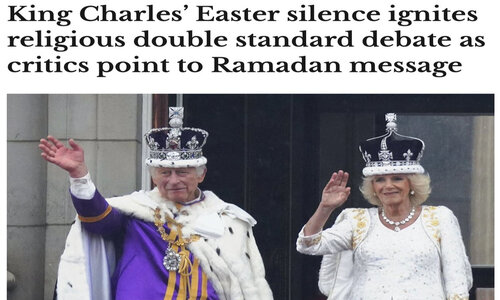
That is why King Charles III's absent Easter message struck such a nerve.
To many, it was not simply about whether a monarch is required to issue a formal statement every Easter. That is the sort of technical argument people use when they want to avoid the bigger issue. The deeper problem is what his silence symbolized.
At a time when Britain is morally fractured, spiritually confused, and increasingly detached from the faith that once anchored it, the head of the Church of England went quiet on the holiest day in the Christian calendar.
And millions noticed.
For many Christians, this was not a minor communications decision. It felt like one more unmistakable sign that Britain's Christian identity is no longer being guarded, honored, or even confidently acknowledged by the very institutions once entrusted to uphold it.
That is not paranoia. It is pattern recognition.
Britain has been drifting away from Christianity for decades, and the consequences are no longer theoretical. This is no longer simply about empty pews or declining baptisms. It is about the collapse of a shared moral framework.
For generations, Christianity gave Britain a moral vocabulary. It taught the dignity of the individual, the sacredness of truth, the value of sacrifice, the duty of charity, the importance of self-restraint, and the sobering truth that freedom without virtue eventually becomes chaos.
That framework is now eroding before our eyes.
What replaces it has not been some enlightened moral upgrade. Instead, Britain increasingly looks like a nation unsure of what it believes, what it stands for, or what it is even trying to preserve. It has become a country of rising loneliness, collapsing trust, ideological tribalism, bureaucratic moral confusion, and elite institutions that seem far more comfortable managing decline than confronting it.
And perhaps most revealing of all, even many non-churchgoing Britons seem to understand that something precious has been lost.
A recent poll found that a majority of Britons are concerned that drifting further from the nation's Christian heritage could harm future generations. That should stop people in their tracks. These are not just committed churchgoers talking. These are ordinary people sensing that when a civilization severs itself from the roots that gave it coherence, it does not become stronger. It becomes disoriented.
People can feel the loss even if they cannot always name it.
And that is what made the King's Easter silence so unsettling.
Because Easter is not a niche observance. It is not just another holiday on the calendar. Easter is the central claim of Christianity--the resurrection of Jesus Christ, the triumph of life over death, hope over despair, truth over darkness. If the King can publicly acknowledge and celebrate a range of faith traditions and causes throughout the year, but cannot clearly and confidently mark Easter, what message does that send about the faith he is sworn to defend?
That question becomes even more troubling when placed alongside the current condition of the Church of England itself.
The church should be a stabilizing force in a collapsing culture. It should be the one institution willing to speak eternal truth into national confusion. It should be able to call a drifting society back to repentance, moral clarity, courage, and hope.
Instead, too often, it feels like the Church of England is drifting right along with the culture.
Which brings us to Sarah Mullally.
For some in the media and political class, her elevation has been framed as historic, modern, and even inspiring. But for many ordinary Christians, especially those already weary of the Church of England's long slide into weakness, her appointment has not inspired confidence. It has deepened concern.
And the reasons are not hard to understand.
Many believers are not upset because they are reflexively hostile to change. They are frustrated because the church's leadership increasingly appears chosen for its ability to navigate institutions, signal cultural acceptability, and maintain establishment respectability--not for bold theological conviction, spiritual seriousness, or a burning urgency to call the nation back to Christ.
That frustration has been building for years.
The Church of England has hemorrhaged relevance not because it has been "too Christian," but because it has often seemed embarrassed by Christianity's sharper edges. Instead of offering moral clarity, it frequently offers carefully managed ambiguity. Instead of sounding like a church grieved by sin and hungry for revival, it often sounds like a committee trying not to offend anyone.
And people are tired of it.
Mullally, for many critics, represents more of that same managerial churchmanship--polished, institutional, socially acceptable, and profoundly unlikely to spark any meaningful spiritual awakening in a nation desperate for one. Her style is seen by critics as emblematic of a church leadership class that is comfortable talking about process, inclusion, structures, and public messaging, while seeming far less urgent about repentance, holiness, salvation, biblical authority, and the person of Jesus Christ.
That is the real complaint.
The concern is not merely about one appointment. It is about what the appointment represents: a church establishment that appears increasingly detached from the spiritual emergency unfolding around it.
Britain does not need a church that knows how to survive headlines.
It needs a church that still believes hell is real, truth matters, sin destroys, grace saves, and Christ is King.
That may sound too blunt for modern Britain. But perhaps modern Britain is in such trouble precisely because it has spent too long softening every truth that once had the power to save it.
And this is where the monarchy matters too.
The British Crown has never been just about pageantry. At its best, it has symbolized continuity, duty, sacred order, and the recognition that a nation must be accountable to something higher than fashion, polling, and political convenience. When that symbolism grows weaker, the loss is not merely religious. It is civilizational.
King Charles may not have intended to ignite this conversation by saying nothing at Easter.
But that is exactly what happened.
His silence became a mirror. And what many Christians saw reflected back was deeply troubling: a Britain increasingly hesitant to honor the faith that built it, a monarchy increasingly cautious about clearly affirming Christianity, and a national church that too often looks more prepared to accommodate decline than confront it.
Still, this does not have to be the end of the story.
History is full of moments when spiritual collapse created the conditions for revival. Sometimes nations only rediscover what is sacred after they have spent years proving that secular substitutes cannot carry the weight.
And Britain may be closer to that moment than many realize.
Because beneath the institutional weakness, the cultural confusion, and the elite embarrassment over Christianity, there remains a quiet but unmistakable truth: people are starving for meaning. They are starving for moral clarity. They are starving for transcendence. They are starving for something sturdier than slogans, identity politics, and empty modern spirituality.
What Britain needs now is not a softer Christianity or a more diluted church.
It needs a bolder one.
It needs leaders who are not ashamed of the gospel. It needs churches that are more concerned with faithfulness than applause. It needs a monarchy willing to honor the Christian inheritance it still formally claims. And it needs a people willing to admit that perhaps the old faith was not the problem after all.
Because when a nation forgets the God who shaped it, it does not become neutral.
It becomes lost.
And King Charles' Easter silence only made that loss harder to ignore.