
The World Wants Calm - But Israel Already Sees The Next War Coming
 By PNW Staff April 09, 2026
Share this article:
There is a dangerous difference between peace and pause -- and Israel knows it.
That is the real story behind the latest ceasefire confusion involving the United States, Iran, and the growing pressure surrounding Israel's military campaign. On paper, the world is once again talking about de-escalation. Diplomats are using familiar words. Negotiators are floating frameworks. Leaders are speaking in the language of restraint. But beneath all of it lies a far more serious truth: Israel is not looking at this moment as the end of a war. It is looking at it as a countdown to the next one.
And that is why Lebanon matters so much.
As new ceasefire terms and contradictory interpretations swirl around Washington, Tehran, and regional intermediaries, one issue is quickly becoming unavoidable: Iran wants Israel stopped in Lebanon. Israel refuses. That disagreement is not a side issue. It may be the single clearest sign that this "ceasefire" is far less stable than many want to admit.
Because if Iran is willing to threaten the entire arrangement over Israeli strikes on Hezbollah, then it tells us something critical: Hezbollah is not a side asset to Iran. It is central to Iran's future war plans.
That is exactly why Israel is moving with such speed and intensity.
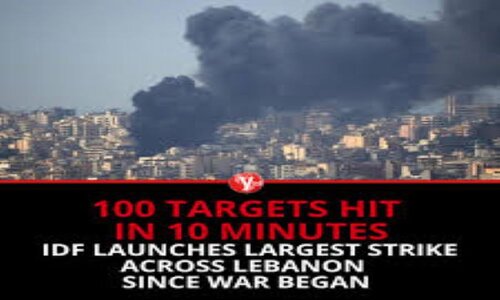
In one breathtaking wave of action, Israel reportedly struck more than 100 Hezbollah sites in just 10 minutes. That kind of operation is not only about military capability -- though it certainly demonstrates that. It is also about urgency. It is about a nation acting like it knows the diplomatic clock may soon run out. It is about a military that understands global pressure can close operational windows before strategic goals are finished.
Israel appears to be operating with a hard reality in mind: if the world forces a pause too early, Hezbollah survives to fight another day.
And for Israel, that is no longer acceptable.
For years, much of the international community treated Hezbollah's presence on Israel's northern border as a manageable problem. Rockets were stockpiled. Tunnels were dug. command centers expanded. Precision missile projects advanced. Iranian influence deepened. Yet the expectation was that Israel should simply absorb the threat, deter it, and hope that another full-scale war could be postponed.
That "stability" was always an illusion.
What the world often called restraint, Israel increasingly saw as strategic decay -- a slow normalization of an enemy army sitting on its border under the protection of diplomatic ambiguity and international hesitation.
That is over now.
Israel is not going back to the old arrangement where Hezbollah builds, arms, embeds, threatens, and waits. It is not going back to a border where Iranian-backed terror infrastructure is tolerated as long as it doesn't explode all at once. The old status quo was not peace. It was a loaded gun left on the table.
And after everything that has unfolded in this region, Israel clearly believes that leaving that gun there again would be suicidal.
This is where many outside observers still miss the bigger picture. Hezbollah matters to Iran not just because it is useful in the present, but because it is essential to the future.
Iran has long relied on layers of proxy power to project force beyond its borders. Hezbollah is perhaps the most important of all of them. It is not merely a militia. It is not simply a regional ally. It is a forward operating arm of Iranian strategy -- one that allows Tehran to pressure Israel, threaten escalation, surround its enemies, and maintain a second battlefield without directly exposing itself first.
In plain terms, Hezbollah is one of Iran's insurance policies against Israel.
That matters even more now.
If Iran's nuclear ambitions have been significantly disrupted or delayed, then Tehran's need for its proxy network only increases. If Iran cannot move toward its long-term strategic goals as quickly through nuclear leverage, it will need missiles, militias, terror infrastructure, and regional alliances all the more.
That means Hezbollah becomes even more valuable.
This is the part many in the West still seem reluctant to say out loud: if Iran cannot get the bomb when it wants it, it will need its terror network for the next attempt at regional domination. And if that day comes, Hezbollah will not just be a supporting actor. It will likely be one of the lead weapons.
That is why Iran is so desperate to preserve it.
And that is why any attempt to force Israel to stop short in Lebanon carries enormous consequences.
If Israel is pressured into halting its campaign before Hezbollah is meaningfully dismantled, the result will not be peace. It will be regeneration. Hezbollah will regroup. It will rebuild logistics. It will restore command channels. It will replenish positions. It will once again disappear into civilian infrastructure, political complexity, and international excuses -- only to emerge later stronger, more disciplined, and even more dangerous.
That is not a theory. That is the pattern.
This is what makes the current moment so consequential. The world wants calm because calm feels morally clean. Calm sounds responsible. Calm polls well. Calm lowers oil panic and diplomatic stress. Calm allows leaders to tell their people the crisis is under control.
But calm without resolution can be a trap.
And Israel knows it.
Israel is acting like a nation that believes it may have one of its last real opportunities to fundamentally alter the military map on its northern front. It is acting like a country that understands something many outside powers do not: you do not defeat long-term threats by preserving them for future negotiations.
You remove them.
That may sound harsh to foreign ears. It may sound escalatory to Western analysts and deeply uncomfortable to governments eager to avoid a wider regional war. But Israel's calculation is rooted in a brutally simple question: If Hezbollah survives this moment intact enough to rearm, what exactly has been solved?
Nothing meaningful.
Only delayed.
And that is the heart of the problem with so many ceasefire discussions in the Middle East. They are often built around the assumption that time itself is healing. But time is not always healing. Sometimes time is what your enemy uses to reload.
Iran understands that.
Israel understands that too.
And that may be why this moment feels so combustible. The United States may be trying to carve out a diplomatic lane. Gulf states may be calculating what comes next. Iran may be trying to preserve room to negotiate, regroup, and survive. But Israel is staring at something far more immediate and existential: the possibility that the world is once again trying to freeze a conflict before the root danger has been removed.
That is why this is not simply about Lebanon. And it is not just about Hezbollah.
It is about whether the world is willing to admit that Iran's ambitions did not begin and end with uranium.
Iran's regional strategy has always depended on more than one tool. Nuclear leverage is one arm of the threat. Proxy warfare is the other. If one is damaged, the other becomes even more important. And if the international community chooses to protect the proxy arm in the name of "stability," then it may be preserving the very mechanism through which the next war will be launched.
That is what Israel sees.
While others see a pause, Israel sees preparation.
While others see de-escalation, Israel sees unfinished danger.
While the world wants calm, Israel already sees the next war coming.
And after everything it has learned, it is increasingly clear that it has no intention of waiting politely for that war to arrive.