Trump's Nebuchadnezzar Moment: A Warning About Pride In The Midst Of Power
 By PNW Staff April 14, 2026
Share this article:

For many Christian supporters of Donald Trump, the past several years have created a complex emotional and spiritual tension. On one hand, there is deep appreciation for his policies, judicial appointments, and political strength on the world stage.
On the other, there is growing discomfort with the increasingly blurred line between political admiration and spiritual exaltation--especially when imagery and rhetoric begin to drift into territory that belongs only to Christ.
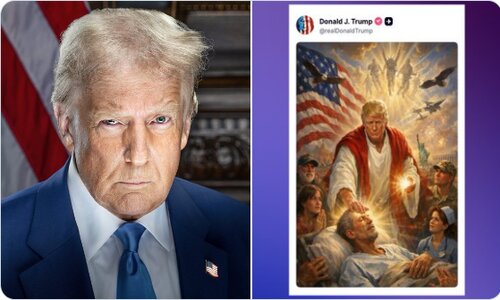
That tension has once again surfaced in the wake of recent online controversy involving an AI-generated image circulated on Trump's Truth Social account, in which he appears to be depicted in a Christ-like role. While the exact intent behind the post has not been clearly explained by Trump or his official representatives, the imagery itself has sparked concern and confusion, even among his most loyal Christian supporters.
For many believers, the question is simple: Why would this be posted at all?
A troubling comparison during Easter
Adding to the unease was a recent Easter-season message involving Trump's spiritual adviser, Paula White, who drew a comparison between the persecution of Jesus and the treatment Trump has received in the political and legal arenas. While the intention may have been to highlight perceived injustice and public hostility, the analogy has raised serious theological concerns among Christians.
The suffering of Christ, according to the New Testament, is unique and redemptive. Jesus' persecution was not merely political--it was salvific, purposeful, and tied to the atonement for sin. To draw a direct parallel between that and the experience of any modern political figure risks collapsing a sacred distinction that Christianity has always held as central: Christ alone is without sin, Christ alone is the Savior, and Christ alone bears the cross for humanity.
For many believers, this kind of comparison--however well-intended--crosses a line from political encouragement into spiritual confusion.
The image that raised more questions than answers
Now, with the circulation of an AI-generated image depicting Trump in place of Jesus, concerns have deepened. The post was made by Trumps Truth Social account but without an official explanation, supporters and critics alike are left to interpret the symbolism on their own. Some may dismiss it as satire, artistic experimentation, or a staff-generated post that escaped careful review. That is certainly possible.
But symbolism matters--especially in an era where images travel faster than explanations.
For Christians, imagery of Christ is not neutral. It carries theological weight. When a political figure is visually placed into that role, even indirectly or unintentionally, it can be perceived as elevating a human leader into a space reserved only for the divine. And even if the intent was not self-exaltation, perception becomes reality in the public square.
Nebuchadnezzar: a sobering biblical parallel
It is in moments like these that many Christians instinctively reach for biblical parallels--not to condemn, but to interpret.
One figure often mentioned in discussions about power, pride, and political greatness is King Nebuchadnezzar of Babylon. Nebuchadnezzar was not a weak or irrelevant ruler; he was arguably the most powerful man of his era. He acknowledged the God of Israel at times, even witnessing divine revelation. Yet he also struggled deeply with pride.
Standing on the roof of his royal palace, he declared:
"Is not this great Babylon, which I have built by my mighty power as a royal residence and for the glory of my majesty?"
But Scripture records what followed:
"While the words were still in his mouth, a voice fell from heaven: 'O King Nebuchadnezzar... the kingdom has departed from you... you shall be driven from among men... until you know that the Most High rules the kingdom of men and gives it to whom he will'" (Daniel 4:29-31).
The biblical warning is clear: unchecked pride in positions of power can lead even the greatest rulers into humiliation and correction.
And Scripture distills it further:
"Pride goes before destruction, and a haughty spirit before a fall" (Proverbs 16:18)
"For everyone who exalts himself will be humbled, and he who humbles himself will be exalted" (Luke 14:11)
The modern concern: where does admiration become elevation?
Among many Christian Trump supporters, there has long been a willingness to see him as a kind of "Cyrus figure" or even, in more cautious theological language, a "Nebuchadnezzar-type leader"--a flawed but powerful ruler whom God can still use for larger purposes despite personal imperfections.
But the danger in such frameworks is not the comparison itself--it is what happens when political admiration begins to drift into spiritual inflation.
The concern some believers are now voicing is not that Trump intends to replace Christ, but that the environment around political devotion can slowly blur sacred boundaries. When language of persecution becomes spiritually heightened, and when imagery begins to place a leader in proximity to Christ, even symbolically, it raises the question: where does honor end and exaltation begin?
The real issue: the heart behind the power
To be fair, no outsider can fully know the intent behind the recent image or posts. It may have been created by staff, generated by AI tools, or shared without theological consideration. It may even have been intended as symbolic or artistic rather than devotional.
But Scripture repeatedly shifts attention away from external interpretation and toward internal condition. The real question is not only what was posted, but what spirit is forming around power, influence, and identity.
Nebuchadnezzar's downfall did not begin with a single act--it began with a posture of the heart.
And that is why this moment feels significant to many believers. Not because one image defines a person, but because patterns of symbolism, language, and influence can gradually reveal deeper tendencies.
A call to humility, not condemnation
For Christian supporters of Donald Trump, this does not have to become a moment of rejection. It can instead become a moment of reflection. If anything, Scripture offers a consistent pattern: God uses imperfect leaders, but He resists pride and calls all rulers--great and small--to humility.
Trump, like every world leader, stands under the same biblical truth that governed Babylon's most powerful king: the Most High rules the kingdoms of men and gives them to whom He wills.
If anything good can come from this controversy, it may be a renewed reminder that political power is never divine power--and that no leader, no matter how influential, should ever be placed in the visual, symbolic, or spiritual space that belongs to Christ alone.
Because in the end, Nebuchadnezzar's story was not only about judgment.
It was about restoration through humility.
And that, perhaps, is the lesson that still echoes across centuries for every powerful man who forgets where true authority comes from.