Britain's Identity Shift: When Citizenship No Longer Has A Shared Story
 By PNW Staff April 14, 2026
Share this article:
Something is breaking in Britain--but it is not loud, and it is not being openly declared. It is happening quietly, inside classrooms, census forms, courtrooms, and the language of public institutions.
A country that once assumed a shared cultural foundation is now asking a far more unsettling question: what, exactly, are we all supposed to share?
A decade ago, commentator Peter Hitchens warned that removing Christianity from public life would not produce a neutral society. It would produce a vacuum. And vacuums, in real societies--not theory--do not stay empty for long. They are filled by something else: the state, competing value systems, or a patchwork of identities that no longer fully agree on what the country is.
Fast forward to Britain today, and that warning feels less like theory and more like description.
The most symbolic example is not found in parliament or church attendance statistics. It is found in citizenship education.
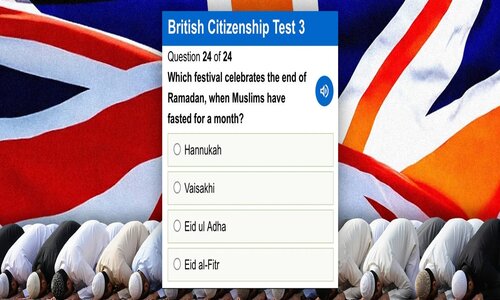
Applicants for British citizenship are now expected to understand core elements of life in modern Britain--including knowledge of major religious traditions and public holidays. That includes Christian festivals like Easter and Christmas, but also Islamic observances such as Eid al-Fitr and Eid al-Adha. Eid al-Fitr marks the end of Ramadan, the month of fasting. Eid al-Adha is tied to pilgrimage and sacrifice.
On paper, this is civic education. In practice, it signals something deeper: Britain no longer teaches citizenship through a single cultural lens. It teaches it through managed pluralism--where the state acts as curator of multiple traditions, rather than guardian of one inherited identity.
And this is where the tension begins.
Because for many citizens, the question is no longer whether Britain is "diverse." It clearly is. The question is whether diversity still sits on top of a shared foundation--or whether that foundation has been quietly removed altogether.
The transformation is visible in data.
The 2021 Census confirmed a historic shift: those identifying as Christian are no longer the majority in England and Wales, while those reporting no religion have surged. Islam, meanwhile, has grown steadily and is now the second-largest religious affiliation. In London, Birmingham, and other major cities, this is not an abstract statistic--it is the lived reality of schools, neighborhoods, and public services.
But the more politically sensitive issue is not simply demographic change. It is institutional adaptation.
Take Sharia arbitration councils in the UK. They have no legal authority, cannot override British courts, and operate only through voluntary participation. Yet their existence continues to generate debate--not because they replace British law, but because they represent something more symbolic: the formal recognition of religious legal reasoning within a secular system that once claimed to be culturally uniform.
Or consider the rapid expansion of faith-based schooling, religious charitable networks, and community institutions that now often fill gaps once occupied by the state or traditional civic organizations.
None of this is illegal. None of this is hidden. In fact, it is publicly documented and, in many cases, publicly funded.
But taken together, it raises a question Britain has not seriously answered:
What happens when a society stops agreeing on what it is?
Polling reflects the uncertainty.
Surveys consistently show that Britons are divided over national identity, integration, and the pace of cultural change. Meanwhile, organizations such as the Community Security Trust have reported significant increases in antisemitic incidents during periods of heightened Middle East conflict, revealing how global tensions are increasingly imported into domestic life.
Yet complexity is not the same as cohesion.
And this is the underlying fracture line: Britain still has institutions, laws, and elections--but it is less certain it has a unifying cultural story that gives those structures shared meaning.
Historically, Britain did not require everyone to agree on everything. But it did assume a broadly shared civilizational grammar--shaped for centuries by Christianity, law, monarchy, and local identity. That grammar has weakened faster than it has been replaced.
What has filled the space is not a single new faith or ideology--but multiple systems of meaning competing within a single civic framework that is no longer confident about its own foundations.
This is why debates about religion in Britain feel so emotionally charged. They are not really about festivals, classrooms, or census categories. They are about something deeper: whether Britain is still a nation with a shared identity, or simply a collection of communities managed under one administrative system.