
The Shared Podium That Left Many Female Athletes Feeling Humiliated
 By PNW Staff May 18, 2026
Share this article:
The scene at the California state track and field finals this week was about far more than medals, podiums, or records. It became yet another flashpoint in a national debate that refuses to go away because, for many parents and female athletes, the issue cuts to something fundamental: fairness.
Transgender athlete AB Hernandez dominated multiple girls’ events at the state finals, winning first place in the high jump, long jump, and triple jump, triggering visible frustration from competitors, parents, and spectators alike. The controversy surrounding transgender participation in girls’ sports has simmered for years, but what unfolded in California showed just how emotionally charged the issue has become.
The reaction in the stadium told the story more clearly than any political talking point could.
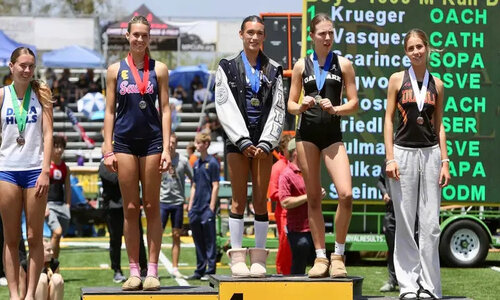
Some female athletes reportedly avoided Hernandez entirely during medal ceremonies. Malia Strange of Shadow Hills High School, who finished behind Hernandez in the triple jump, declined to appear on the podium. Parents wore “Protect Girls Sports” shirts in protest. Tournament officials, evidently aware of the optics and backlash surrounding the competition, handed out additional gold medals to biological female athletes who finished second behind Hernandez.
But the controversy went even further than that.
Under a pilot program enacted by the California Interscholastic Federation (CIF), any biological female athlete who finished behind a transgender athlete was elevated one placement higher. The policy also allowed girls who narrowly missed qualifying for state finals due to competing against a transgender athlete to still advance.
The result was one of the most surreal images in modern high school sports: female athletes being required to share podium spots with the very athlete many believed held an unfair biological advantage over them.
Photos and videos of Hernandez standing atop shared podiums alongside female runners-up spread rapidly across social media, igniting outrage nationwide. For many critics, the shared podium arrangement spoke volumes. Officials appeared to be attempting to symbolically preserve fairness without actually addressing the underlying issue itself.
If the competition were truly viewed as fair and equal, critics asked, why was there any need to redesign the ceremony at all?
That question became central to the backlash.
Many online commenters described the scene as deeply uncomfortable, arguing that female athletes were effectively being asked to publicly celebrate circumstances they privately believed were unjust. Others argued the split-podium system unintentionally revealed that even officials understood the competitive imbalance but lacked the willingness to directly confront it.
And that is the central issue driving the outrage.
The question is whether biological differences matter in competitive athletics.
For decades, women fought to create protected spaces in sports precisely because those biological differences were recognized as real and consequential. Title IX was not created because male and female athletic performance is identical. It was created because it is not.
Elite-level competition is often decided by fractions of inches, split seconds, or tiny advantages in explosiveness, muscle density, wingspan, bone structure, lung capacity, and recovery. Even after hormone treatment, many sports scientists and female athletes argue that biological males retain advantages that cannot simply be erased. Many parents and athletes pointed to the results in California as evidence of those concerns, noting that Hernandez beat the field in the girls’ long jump by over a foot — an enormous margin in elite high school competition where events are often decided by mere inches.
That is why so many female athletes increasingly feel they are being forced into an impossible position: stay silent or risk being labeled hateful.
Olivia Viola’s mother, Tracy Howton, captured the frustration many parents now feel when she said her daughter was simply “fighting for the rights of female athletes.”
“She thinks it’s a fundamental issue of fairness for women,” Howton said. “It shouldn’t be that controversial.”
Yet in many progressive political circles, it has become controversial to even say biological sex exists in meaningful athletic terms. Critics of transgender participation policies are frequently branded as bullies, extremists, or bigots regardless of how respectfully they raise concerns.
California Governor Gavin Newsom has faced growing criticism from parents who believe state leaders have ignored the concerns of female athletes altogether. Howton accused Newsom of trying to silence dissent by portraying girls who object as aggressors rather than victims of an unfair system.
Across the country, this issue has become increasingly toxic for Democrats, particularly among suburban parents and women who traditionally supported progressive causes but now feel uncomfortable with the direction of the debate. Polling consistently shows that a majority of Americans oppose biological males competing in women’s sports, especially in high school and collegiate competition.
What happened in California may only deepen that divide.
The images coming out of the event were striking precisely because they did not look celebratory. They looked tense, awkward, and emotionally divided. Athletes standing apart from one another. Officials improvising ceremonies to soften public backlash. Parents protesting from the stands. Young women appearing afraid to openly express frustration.
That is not unity. That is managed conflict.
And perhaps the most revealing part of all is that officials themselves appear to understand the public relations problem. If they truly believed there was no fairness issue whatsoever, why alter the ceremony? Why create duplicate honors? Why attempt to symbolically compensate biological female athletes afterward?
Because deep down, even many supporters of these policies recognize the discomfort Americans feel when watching biological males dominate girls’ competition.
The tragedy is that young athletes on all sides are now being placed in the center of a political and cultural battle adults refuse to resolve honestly. Female athletes should not have to choose between silence and social backlash. Transgender athletes should not be turned into political weapons by activist groups seeking to force cultural change through sports.
But pretending there are no legitimate fairness concerns is only making the conflict worse.
Sports depend on trust in the integrity of competition. Once athletes and parents begin believing the rules themselves are unfair, the entire foundation starts to crack. And judging by the outrage erupting in California, many Americans believe that crack is growing wider by the day.