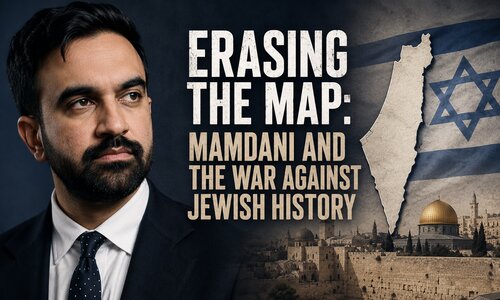
Erasing The Map: Mamdani And The War Against Jewish History
 By PNW Staff July 27, 2026
Share this article:
Maps do more than identify places. They tell us whose history matters, whose identity deserves recognition—and who can quietly be made to disappear.
That is why a recent New York City map of immigrant neighborhoods created such an uproar. It highlighted 30 communities, including Little Pakistan, Little Yemen and Little Palestine. Yet Little Italy and several prominent Irish and Jewish neighborhoods were nowhere to be found.
Mayor Zohran Mamdani promised that changes would be made after fierce backlash from those communities.
The map story reveals how easily official institutions can elevate one version of history while allowing another to fade from public view. A community does not need to be physically destroyed to be erased. Sometimes it simply stops appearing on the map.
That same battle over memory now stands at the center of the Israeli-Palestinian conflict.
The War Before The War
Long before missiles are launched or borders are redrawn, a different kind of war begins—a war over the past.
Israel’s opponents increasingly describe the Jewish state as an artificial European colony imposed upon an indigenous Palestinian population. In this telling, Jews are recent foreign settlers with no more authentic connection to Jerusalem than the British had to India or the French had to Algeria.
Once that narrative is accepted, Israel’s elimination can be repackaged as “decolonization.”
But it requires thousands of years of Jewish history to disappear.
The Jewish connection to the land did not begin with the Holocaust, the British Mandate or the founding of modern Israel in 1948. It reaches back to the ancient kingdoms of Israel and Judah, the reigns of David and Solomon, the temples in Jerusalem and the prophets whose writings still shape Western civilization.
Jerusalem was the center of Jewish religious and national life centuries before Christianity existed and more than a millennium before the rise of Islam.
Foreign empires repeatedly conquered the land. Assyrians, Babylonians, Persians, Greeks, Romans, Byzantines, Arab Muslim armies, Crusaders, Mamluks, Ottomans and the British all exercised control at different points.
Jewish sovereignty was lost, and large numbers of Jews were expelled or scattered. Yet the Jewish connection was never extinguished. Jewish communities remained in the land through centuries of conquest, while Jews throughout the diaspora continued praying toward Jerusalem, celebrating Passover with the hope of returning and preserving an identity inseparable from Zion.
The people were dispersed. They were not invented.
Rewriting Mary & Jesus
The struggle to rewrite Jewish history has now reached even into the Christian story.
A recent Muslim women’s retreat associated with New York City First Lady Rama Duwaji reportedly presented Mary as “a Palestinian woman who gave birth under occupation.” Such language illustrates the larger effort to impose modern political identities upon the ancient world.
Mary lived under Roman rule, but she was not a Palestinian in the modern national sense. She was Miriam, a Jewish woman living among the Jewish people. Her faith, family, worship, Scriptures and hope for the Messiah were all rooted in Israel.
Jesus was Jewish. His disciples were Jewish. The apostles were Jewish. The Gospel unfolded within Jewish history, Jewish prophecy and Jewish expectations.
Calling Mary “Palestinian” without explaining that identity is not historical clarification. It is historical replacement.
This effort to rewrite the biblical story is not new. Palestinian leaders have used similar language for decades. When the Palestinian Authority assumed control of Bethlehem in 1995, Yasser Arafat was reported to have welcomed visitors to the birthplace of “the first Palestinian Christian—Jesus Christ.” In 2013, Mahmoud Abbas went further, describing Jesus as a “Palestinian messenger” who became a light to the world. The political appeal is obvious: placing Jesus inside the modern Palestinian national story connects the Palestinian cause to Christianity’s most sacred figure, strengthens claims of ancient indigeneity and invites Christians worldwide to view the present conflict through the imagery of Bethlehem, occupation and suffering.
But the comparison depends upon an anachronism. Jesus was born into the Jewish people, worshiped the God of Israel, observed Jewish festivals, taught from the Hebrew Scriptures and was crucified by Rome under the title “King of the Jews.” To recast Him primarily as a modern Palestinian resistance figure does more than express solidarity with Palestinians; it appropriates His identity while severing Him from the Jewish history that explains who He was.
This should concern Christians as much as Jews. When the Jewish identity of Mary, Jesus and the apostles is minimized, Christianity is slowly detached from the biblical story that gave birth to it. The Bible becomes a collection of spiritual metaphors rather than the record of God working through real people, in real places, across real history.
Whoever Controls The Map
The controversy over New York’s immigrant map may appear insignificant beside the struggle over Jerusalem. Yet both involve the same basic question:
Who gets to appear on the map?
Historical erasure rarely announces itself openly. It begins with selective language, selective recognition and selective outrage. Certain identities are celebrated. Others become inconvenient. Eventually the public is taught that the inconvenient people were never truly there at all
Before Israel can be delegitimized politically, it must be erased historically. Before Jews can be portrayed as foreign occupiers, their temples, kingdoms, communities, prayers and centuries of attachment must be pushed outside the approved narrative.
A name is omitted. A history is simplified. An ancient people are reclassified as outsiders.
Then one day, the world looks at the map and wonders why they are still there.