
The Women Nobody Wants To Talk About In The Transgender Debate
 By PNW Staff September 05, 2026
Share this article:
For years, one of the most visible consequences of transgender policies has played out in women's sports.
Female athletes have watched biological males enter their competitions, stand on podiums, occupy roster spots and, in some cases, enter spaces once reserved exclusively for women. Whatever one's position on transgender issues, the conflict has forced society to confront an uncomfortable question: What happens when the interests of people who identify as transgender collide with protections created specifically for women?
But there is another group of women caught in that collision who receive considerably less public attention.
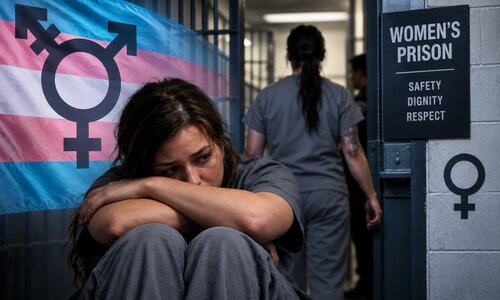
They are women in prison.
And developments in Canada demonstrate why the issue extends far beyond trophies, records and athletic scholarships.
When Inclusion Enters The Prison System
Canada's federal government recently acknowledged in court filings that two transgender inmates housed in women's prisons faced sexual-assault charges following complaints from female prisoners.
The allegations emerged as part of a constitutional challenge to Correctional Service Canada's policy governing "gender diverse" offenders. Plaintiffs challenging the policy have identified 45 female prisoners allegedly affected in 59 incidents of harm involving gender-diverse inmates.
The government's own numbers reveal something else that deserves attention.
Between fiscal years 2017-18 and 2024-25, 57 individuals who were male at birth submitted 129 requests seeking placement or transfer into women's institutions.
Thirty-five requests were approved, 72 were denied and 22 were withdrawn.
As of October 2025, Canada had 90 self-identified transgender women in federal custody.
This is no longer a theoretical discussion about what might someday happen. Prison officials are already being asked repeatedly to decide when someone born male should be permitted to live among incarcerated women.
Why Women's Prisons Exist
There is an obvious question that increasingly gets lost in discussions about gender identity: Why did society separate male and female prisoners in the first place?
It wasn't arbitrary.
Men and women were separated because biological sex matters in environments where people sleep, shower, change clothes and live together under conditions they cannot simply leave.
The vulnerability of female prisoners makes that distinction particularly important.
Correctional Service Canada itself acknowledges that federally sentenced women are more likely than the average Canadian to have histories of physical or sexual abuse. Its correctional programs for women are deliberately designed around a "women-centred" and trauma-informed approach.
That produces an extraordinary contradiction.
The correctional system recognizes that women constitute a distinct population with unique vulnerabilities requiring specialized protection and treatment. Yet its gender policy allows prisoners who were born male to request placement among that same population based upon gender identity.
The government says those transfers are assessed individually, including consideration of security risks and the safety of other prisoners. Indeed, the fact that 72 of 129 requests were denied demonstrates officials do reject transfers when concerns cannot be adequately addressed.
But that raises another question.
If biological sex is irrelevant to whether someone belongs in a women's prison, why is such extensive risk assessment necessary in the first place?
Some Risks Cannot Simply Be Wished Away
Correctional Service Canada's own research into gender-diverse prisoners with histories of sexual offending found that more than 80 percent of that subgroup were transgender women. Among those offenders, 88 percent had prior sex-offense convictions, 94 percent had committed their offenses while living as their biological sex, and 55 percent of victims were female.
Those statistics do not tell us that transgender people generally are dangerous. They tell us something much narrower but extremely relevant to prison policy: there are male-born prisoners identifying as women who have serious histories of sexual violence, including violence against females.
That reality cannot disappear simply because someone's gender identity changes.
The Forgotten Side Of The Debate
Women's sports attracted attention because the consequences were visible.
People could watch a race, examine a record or see who stood on the podium.
Prisons are different. The women affected are largely invisible to the public, and incarcerated women are not exactly a politically powerful constituency.
Yet their rights still matter.
So do the rights of women in domestic-violence shelters, changing rooms and other environments created specifically to provide privacy or protection based upon sex.
The deeper question raised by Canada's prison controversy is therefore larger than corrections.
For years, society was told that accepting gender identity as distinct from biological sex was primarily about tolerance and compassion. But once that principle becomes embedded in law and institutional policy, difficult conflicts inevitably emerge.
What happens when one person's claim to inclusion affects another person's privacy?
What happens when inclusion potentially affects safety?
Those questions cannot simply be dismissed as intolerance.
Women's sports may have been where many people first noticed the conflict between biological sex and gender identity.
Women's prisons demonstrate just how consequential that conflict can become.
And unlike a championship trophy, the stakes here can involve something far more important than who wins or loses.
They can involve the safety, privacy and dignity of women who have nowhere else to go.