
Playing God With The Weather: Are We Opening A Door We Can't Close?
 By PNW Staff September 05, 2026
Share this article:
Let's begin by getting something out of the way.
Weather modification is not a conspiracy theory.
It is happening right now.
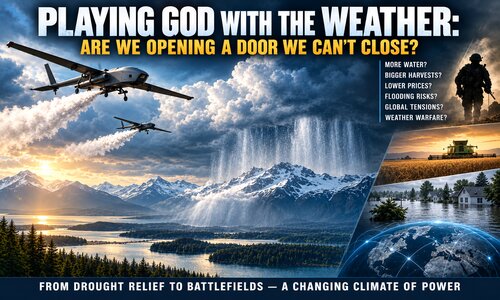
On August 23, a California weather-technology company called Rainmaker sent drones into clouds over Alaska's Kenai Peninsula. The company says its aircraft conducted seven coordinated cloud-seeding missions, releasing silver iodide into clouds already containing moisture.
Rainmaker estimates that the operation generated between 45 and 65 acre-feet of additional precipitation, with an average estimate of 57.6 acre-feet.
That's roughly 19 million gallons of water.
In about three hours.
The figure is Rainmaker's estimate rather than an independently verified measurement, and the company acknowledges uncertainties in calculating exactly how much precipitation ultimately reached the ground. But the experiment illustrates something important.
Human beings are becoming increasingly capable of deliberately influencing weather.
And the technology is getting better.
This Isn't The Cloud Seeding Of The Past
Cloud seeding has existed for roughly 80 years. The basic concept isn't particularly mysterious.
Certain clouds contain supercooled water droplets that remain liquid below freezing. Introducing particles such as silver iodide can encourage ice crystals to form. Those crystals can grow until they eventually fall as snow or rain.
Cloud seeding cannot create a storm out of a clear blue sky. It requires the right atmospheric conditions, and its effectiveness remains difficult to quantify.
A 2024 Government Accountability Office review found estimates of additional precipitation from cloud seeding ranging from zero to 20 percent.
What is changing is everything surrounding the process.
Instead of simply sending airplanes into promising clouds, companies can increasingly combine drones, sophisticated radar, atmospheric sensors, satellite information and computer modeling to identify where and when seeding may have the greatest effect.
Rainmaker's system includes autonomous drones capable of flying through severe icing conditions and software that forecasts seeding opportunities, monitors missions and estimates precipitation.
The old experiment is becoming a technology platform.
Why Should You Care?
Because weather is money.
A prolonged drought can devastate farmers, increase food prices, reduce hydroelectric generation and drain reservoirs. Too much precipitation can destroy crops, flood homes, close highways and disrupt supply chains.
Snowpack determines how much water will eventually flow into reservoirs serving farms and cities. Rainfall can influence commodity prices. A major storm can produce billions of dollars in insurance losses.
So imagine a future in which weather modification becomes increasingly common.
If a company successfully increases mountain snowfall by 10 percent, communities downstream might gain enormous amounts of additional water.
But what happens when something goes wrong?
Suppose cloud-seeding operations are underway and an area subsequently experiences damaging flooding. Did the seeding contribute? By how much? Who is liable?
What if farmers believe precipitation was increased over one region at the expense of another?
What if a state attempts to increase its water supply from clouds that would subsequently have traveled into a neighboring state?
The science may ultimately show that many such accusations are unfounded. But once humans deliberately intervene in atmospheric processes, separating natural weather from human influence becomes enormously important economically, legally and politically.
Even the federal government's watchdog says significant uncertainties remain. The GAO concluded that reliable information about cloud-seeding effectiveness and effects remains limited, while the consequences of much more widespread use of silver iodide are not fully known.
Meanwhile, federal oversight has struggled to keep pace. In February, the GAO reported that NOAA was not fully meeting its responsibilities for maintaining and publicly reporting information about weather-modification activities, estimating that more than half of reports filed with NOAA likely contained errors.
Weather Has Already Been Used As A Weapon
This is where the story becomes considerably more unsettling.
Weather warfare isn't science fiction either.
During the Vietnam War, the United States conducted a classified weather-modification program known as Project Popeye.
Declassified State Department documents describe the objective plainly: produce enough rainfall along infiltration routes in North Vietnam and Laos to interfere with truck traffic.
Clouds were seeded in an effort to prolong rainfall and make enemy supply routes more difficult to use.
Think about what that means.
More than half a century ago, governments already understood that weather could potentially become part of the battlefield.
The international community eventually responded. The Environmental Modification Convention, which entered into force in 1978, prohibits military or other hostile use of environmental modification techniques having widespread, long-lasting or severe effects.
There is a treaty against environmental warfare because governments recognized the possibility was serious enough to require one.
What Happens When AI Enters The Equation?
Now compare the technology of the Vietnam era with what is emerging today.
Drones can fly without putting pilots at risk. Satellites continuously monitor atmospheric systems. Radar can observe precipitation. Sensors can measure conditions inside clouds. Computer systems can identify favorable opportunities.
Artificial intelligence could make those capabilities even more powerful.
Imagine autonomous systems continuously examining enormous regions for atmospheric conditions suitable for intervention, then coordinating fleets of drones to act when those conditions appear.
That does not mean governments can manufacture hurricanes or order thunderstorms like weapons from a catalog. They cannot.
But warfare rarely requires controlling nature perfectly.
Sometimes an advantage is enough.
If weather modification could someday increase rainfall over supply routes, worsen muddy battlefield conditions, increase mountain snowfall, interfere with visibility or otherwise complicate military logistics, strategists would have obvious reasons to study it.
History tells us they already have.
Who Owns The Rain?
There are potentially tremendous benefits to this technology.
The American West faces serious water challenges. Additional snowfall in important watersheds could increase reservoir supplies, support agriculture and provide communities with desperately needed water.
That shouldn't be dismissed.
But neither should the questions surrounding increasingly sophisticated weather modification.
Who authorizes it?
Who monitors it?
Who determines whether it worked?
Who pays when something goes wrong?
What happens when neighboring states—or neighboring countries—disagree about who should be manipulating atmospheric systems passing over their territory?
And what happens when technology developed to fight drought becomes attractive to militaries seeking strategic advantage?
The greatest concern may not be what cloud seeding can accomplish today.
It is where the technology is heading.
For decades, mankind could influence weather only crudely and under very specific circumstances. Now drones, satellites, sensors, advanced forecasting and artificial intelligence are beginning to converge.
The Alaska experiment should therefore get our attention for reasons extending far beyond 19 million gallons of rain.
The question is no longer whether humans will attempt to modify the weather.
We already are.
The more important question is whether we fully understand what happens when we get increasingly good at it.