
The Kill Switch Beneath The Ocean
 By PNW Staff September 15, 2026
Share this article:
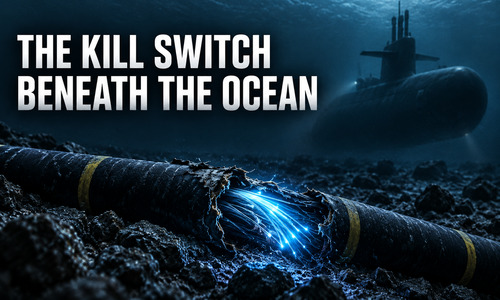
The opening strike of the next major war may not be a missile exploding over a city. It could happen silently, thousands of feet beneath the ocean, as specialized submarines sever the fiber-optic cables carrying the modern world’s most important communications.
No fireball would appear on television. No invading army would cross a border. Yet banks could lose contact with overseas markets, cloud services could become unreachable, shipping networks could be disrupted, military communications could be degraded, and entire countries could suddenly find themselves digitally isolated.
That nightmare moved closer to reality this spring when Russian vessels reportedly practiced deploying technology designed to disable critical undersea cables near Norway’s Svalbard archipelago.
Russia Rehearses Beneath The Waves
According to Reuters, British, Norwegian and American forces tracked and confronted Russian vessels involved in the alleged operation. Western officials said deep-sea submersibles simulated deploying sophisticated equipment capable of damaging undersea infrastructure.
The exercise was reportedly conducted by Russia’s Main Directorate for Deep Sea Research, better known as GUGI. Despite its scientific-sounding name, GUGI is a highly secretive military organization associated with submarine surveillance, seabed mapping and operations involving foreign communications infrastructure.
No cables were damaged, and Russia has not confirmed the Western account. But Norway had already warned that Russian vessels were mapping critical infrastructure and developing the ability to threaten it at extreme depths.
The operation looks less like ordinary intelligence gathering and more like preparation for a future option: the ability to disconnect an enemy before attacking it.
The Internet Is Not Floating In The Cloud
Most people imagine the internet as a wireless system carried by satellites and invisible signals. In reality, the international internet is overwhelmingly physical.
More than 99 percent of international data traffic moves through submarine telecommunications cables. Hundreds of cable systems stretch across the seabed, linking continents and carrying financial transactions, government communications, video calls, corporate data and cloud traffic.
Satellites are important, but they cannot absorb anything close to the enormous volume carried by fiber-optic cables. Even services such as Starlink depend on ground stations, terrestrial networks and command systems that could also be attacked.
The cloud has an address—and much of the road leading to it runs along the bottom of the ocean.
Cut The Cables, Cripple The World
A single damaged cable would not shut down the internet. Cable breaks occur regularly because of anchors, fishing activity, earthquakes and other accidents. Traffic is generally redirected while repair ships restore the connection.
A coordinated wartime attack would be entirely different. An adversary could target several major routes simultaneously while launching cyberattacks against data centers, power grids and telecommunications providers. Satellites and ground stations could also come under attack, limiting the systems expected to provide backup connectivity.
The result might not be a complete global blackout, but it could produce severe congestion, regional isolation and cascading failures across systems that were never designed to operate independently for long.
International payments could stall. Companies could lose access to overseas servers and customer records. Airlines and shipping firms could struggle to coordinate operations. Governments could have difficulty communicating with allies. Hospitals, utilities and emergency agencies could lose access to outside platforms and information.
Even organizing the response would become harder if the communications systems needed to coordinate repairs were themselves failing.
The Perfect Gray-Zone Weapon
Undersea sabotage offers another advantage to an aggressor: uncertainty.
A pipeline explosion or cable break does not immediately reveal who caused it. Investigators may need weeks or months to examine the damage, trace the vessels operating nearby and determine whether the incident was deliberate. By then, the economic and strategic damage may already be done.
The attacker could deny responsibility, blame a commercial ship or suggest that the event was an accident. Governments would face enormous pressure to respond while still lacking evidence strong enough to justify military retaliation.
That makes subsea infrastructure an ideal gray-zone target. It can be attacked without an invasion, damaged without a declaration of war and potentially disabled without leaving an obvious trail back to the perpetrator.
The destruction of the Nord Stream pipelines in 2022 demonstrated how vulnerable major underwater infrastructure can be. Years later, arguments over who ordered the attack continue. Internet cables present an even larger and more dispersed collection of potential targets.
A Global Economy Built On Fragile Threads
Modern countries have spent decades moving essential services online. Financial systems, government agencies, supply chains and communications networks have become faster and more efficient, but also more interdependent.
The system works because connectivity is assumed.
Businesses expect payments to clear instantly. Hospitals expect records to remain accessible. Stores expect electronic inventory systems to function. Families expect mobile phones and messaging platforms to connect them during an emergency. Governments expect to communicate securely with military forces and foreign allies.
Russia is not the only nation capable of targeting those expectations. China possesses advanced naval, cyber and anti-satellite capabilities. Smaller governments, proxy organizations and criminal groups may not be able to cause a worldwide communications crisis, but damaging poorly protected cables in shallow waters does not always require advanced military technology.
War’s New First Strike
Nations once prepared for wars that began with bombers, tanks and ballistic missiles. They must now prepare for conflicts that begin with severed cables, disabled satellites, corrupted data and millions of people staring at screens that no longer connect to anything.
Russia’s reported Arctic exercise was interrupted, but the vulnerability it exposed remains. The cables are still on the seabed. The landing stations are still identifiable. The global economy is still dependent upon them.
The kill switch beneath the ocean may never be pulled. But hostile governments are clearly studying how to reach it.