America Still Believes In The Supernatural - Just Not Necessarily The Bible
 By PNW Staff October 15, 2026
Share this article:
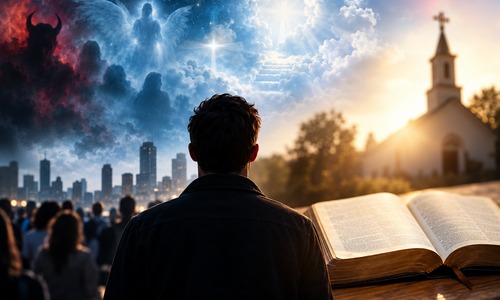
America may be growing more secular, but it has hardly stopped believing in the supernatural.
Millions of Americans still believe in God, heaven, hell, angels, demons, spiritual attacks and divine intervention. They believe there is something beyond the physical world, something that science cannot fully explain and human eyes cannot see.
Yet when it comes to the supernatural events at the very heart of Christianity, that confidence begins to crumble.
According to new research from the American Bible Society's 2026 State of the Bible report, fewer than half of Americans now believe that Jesus Christ was born of a virgin through the miraculous work of the Holy Spirit.
Only 49% believe the virgin birth is at least probably true. Just 53% believe in the resurrection of Jesus Christ, while only 44% believe God miraculously parted the Red Sea for the Israelites.
At the same time, approximately 62% of American adults -- an estimated 171 million people -- believe in the supernatural.
The contradiction is remarkable. America has not rejected the possibility of miracles. Increasingly, however, Americans appear uncertain about the particular miracles recorded in Scripture.
And that raises a much larger question: What happens to a nation that remains spiritually curious but becomes increasingly disconnected from biblical truth?
A Nation That Wants The Supernatural Without Biblical Authority
For years, the prevailing narrative has been that modern Americans are becoming too educated, sophisticated or scientifically minded to believe in supernatural events.
But these findings suggest something more complicated.
Many Americans remain convinced that reality extends beyond what can be measured in a laboratory. They believe spiritual forces exist, that life continues beyond death and that unseen powers may influence the physical world.
The issue is not necessarily an unwillingness to believe in the supernatural. It is an unwillingness, or at least a growing hesitation, to accept the Bible as the authoritative explanation of that supernatural reality.
This distinction is enormous.
Christianity does not simply teach that mysterious spiritual forces exist. It teaches that the universe was created by a personal God, that humanity has fallen into sin, that Jesus Christ entered human history through a miraculous conception, and that He physically rose from the dead after dying for the sins of the world.
Remove those events, and Christianity is no longer the faith proclaimed by the apostles.
The virgin birth is not an optional Christmas embellishment. The resurrection is not merely a metaphor for hope or renewal. These are foundational claims about who Jesus Christ is and what He accomplished.
The Apostle Paul made the stakes unmistakable in 1 Corinthians 15:14: "And if Christ be not risen, then is our preaching vain, and your faith is also vain."
Christianity stands or falls on the truth of what God has revealed, not simply on whether its moral teachings make people feel better.
The Surprising Divide Between Cultural And Practicing Christians
There is, however, an encouraging and important finding buried within the survey.
Among practicing Christians, belief in biblical miracles remains extraordinarily strong.
An overwhelming 97% affirm the virgin birth, 99% believe in the resurrection of Jesus, and 92% believe God parted the Red Sea.
Those figures challenge the idea that committed Christians are broadly abandoning the supernatural foundations of their faith.
Instead, the research highlights a significant divide between the wider American population and those who actively practice Christianity.
For generations, identifying as Christian has been part of American cultural life. Many people grew up attending church, celebrating Christmas and Easter, and considering Christianity part of their family heritage.
But identifying with Christianity culturally is not necessarily the same as understanding or embracing its doctrines.
Someone may admire Jesus as a moral teacher while rejecting His miracles. Another may believe in God but question whether Scripture accurately records His actions. Still another may embrace Christian values while treating biblical teachings as suggestions rather than divine revelation.
The danger emerges when this selective approach enters the Church itself.
When biblical teachings are accepted or rejected according to cultural popularity, personal comfort or contemporary expectations, Scripture ceases to function as the authority over belief. Instead, individual preference becomes the authority over Scripture.
And once that principle is established, there is little reason for the process to stop with the virgin birth.
Spiritual Warfare Is Real To Many Christians -- But Where Is The Bible?
Another striking section of the American Bible Society report examines personal experiences with the supernatural.
Among practicing Christians, 58% reported experiencing a spiritual attack, 69% reported experiencing divine healing, and 90% reported receiving an answer to prayer.
These are self-reported experiences, but they demonstrate how deeply belief in God's activity and the spiritual realm remains embedded in the lives of practicing Christians.
Yet the responses to spiritual attacks reveal a potentially troubling weakness.
Among respondents who reported experiencing spiritual attacks, 74% identified prayer as helpful, 36% selected declaring the authority of Jesus Christ, and 24% selected listening to praise and worship music.
Only 15% selected meditating on or quoting Scripture.
That does not mean the others never read their Bibles. But it does raise an important question about the place of God's Word in the way believers confront spiritual challenges.
When Jesus was tempted by Satan in the wilderness, He responded repeatedly with Scripture.
"It is written," He declared.
Three times Satan tempted Him, and three times Jesus answered with the written Word of God.
The lesson could hardly be clearer.
Prayer is essential. Worship is important. But believers are not called to confront spiritual deception through feelings, experiences or declarations disconnected from biblical truth.
Ephesians 6 describes the Word of God as "the sword of the Spirit," part of the spiritual armor Christians are commanded to put on.
A Church that believes in spiritual warfare but neglects Scripture risks becoming spiritually enthusiastic while remaining biblically vulnerable.
The Church's Challenge Is Bigger Than Declining Church Attendance
The American Bible Society's findings point toward a challenge that cannot be solved simply by increasing attendance, improving worship experiences or making Christianity more culturally appealing.
The deeper issue is whether Americans understand what Christianity actually teaches and why those teachings matter.
A generation can grow up familiar with the name of Jesus while knowing little about His identity. People can celebrate Christmas without believing in the virgin birth, observe Easter without affirming the resurrection, and speak of heaven without understanding the biblical message of salvation.
Religious familiarity is not the same as biblical faith.
Yet the findings also reveal an extraordinary opportunity.
If 171 million American adults believe in the supernatural, then the spiritual questions that Christianity addresses have hardly disappeared.
People are still asking whether God exists, whether evil has a supernatural dimension, whether prayers are answered and what happens after death.
The Church does not need to manufacture spiritual curiosity. Much of that curiosity already exists.
What it must do is direct those questions toward the truth of Scripture rather than allowing them to be answered exclusively by popular culture, personal experiences, mystical speculation or whatever spiritual ideas happen to be fashionable.
That requires pastors willing to teach difficult doctrines, parents willing to explain biblical truth to their children, and Christians prepared to give thoughtful answers for what they believe.
It also requires recognizing that making Christianity more acceptable by removing its supernatural claims ultimately removes the very message the Church exists to proclaim.
The virgin birth, the resurrection, divine judgment and the authority of Scripture are not embarrassing relics of a less enlightened age. They are essential elements of the biblical account of God's work in human history.
America has not lost its appetite for the supernatural. What it is increasingly uncertain about is whether the Bible can be trusted to explain it.
And perhaps that is the greatest challenge -- and one of the greatest opportunities -- facing the American Church today.