When Pastors Rewrite The Bible To Fit The Latest Ideology
 By PNW Staff November 18, 2026
Share this article:
The greatest evidence of God’s patience may be the steady stream of sermons that twist His Word to fit the spirit of the age.
A Lutheran pastor recently told her congregation that Joseph’s coat of many colors may have been a “pretty princess dress.” She then suggested that Joseph was a queer child who suffered violence because his brothers hated him for being queer.
That sermon is not an isolated case. Other pastors are recasting biblical figures through modern gender and sexuality categories, then presenting those interpretations as lessons the church needs to hear today. The details change. The method does not.
Joseph Gets a Makeover
Genesis says Jacob favored Joseph, his brothers hated him, and they eventually sold him into slavery. It says nothing about Joseph being queer.
The pastor builds her interpretation on speculation about the garment. She moves from the possibility that it resembled clothing worn by women to the claim that Joseph may have been a queer child targeted for who he was. From there, she asks what such a child could teach us about God.
That is a remarkable leap. A disputed detail becomes evidence for a modern identity; the identity becomes the key to understanding Joseph’s suffering; and the story is recast as a message about affirming people’s “true and whole” selves.
The text does not make that argument. The preacher does.
When Every Bible Story Becomes a Message
The same approach appears in sermons about the Ethiopian eunuch and Jacob.
At Myers Park Covenant Church, Rev. Dr. Tim Moore used the Ethiopian eunuch’s story in Acts 8 to connect the man’s ancient status to modern transgender and gay identities, then asked what that meant for LGBTQ inclusion. Acts says Philip explained the gospel and baptized the eunuch. It does not identify him as transgender or gay.
At Bethel Community, a guest preacher framed Jacob’s wrestling and new name in Genesis 32 through trans identity, asking how trans Christians might model “co-creating” identities with God. Genesis presents Jacob’s encounter as a struggle with God before he meets Esau. It does not describe a gender transition or teach that people create their own identities.
In each case, a preacher takes a biblical story, overlays it with contemporary identity politics, and draws a conclusion the passage itself never states. The Bible becomes a collection of characters to recruit for a cause.
The Pulpit Follows the Culture
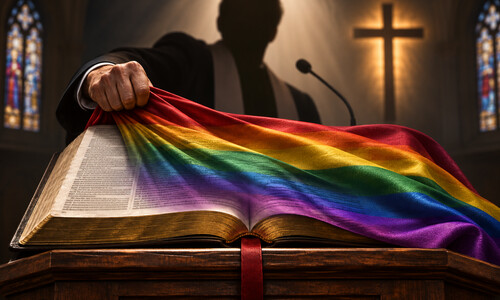
Why is this happening? Because some churches have begun treating current cultural beliefs as the lens through which Scripture must be read. The preacher starts with the desired message, searches for a biblical character who can be made to fit, and then presents that connection as spiritual insight.
The result may sound compassionate and relevant. But it reverses the proper relationship between the church and Scripture. Christians are called to be corrected by God’s Word, not to reshape it until it approves of whatever the culture currently celebrates.
This matters because congregations trust their pastors to explain the Bible faithfully. When speculation is preached as biblical truth, listeners can leave believing the text says something it never says. Over time, Scripture’s authority gives way to the preacher’s assumptions.
A robe becomes proof of queerness. A eunuch becomes a transgender precedent. A new name becomes a lesson in self-creation. The church is no longer asking what God has said; it is asking how His Word can be made to endorse the message of the moment.
The pulpit is meant to proclaim Scripture, not rewrite it. When pastors turn biblical stories into mirrors for modern ideology, they are not helping the church understand God’s Word. They are teaching the church to replace it.