Sermon Illustrations Gone Wrong: Pastor Plays Grand Theft Auto During Message
 By PNW Staff November 24, 2026
Share this article:
A good illustration helps people see a truth more clearly. A bad one leaves them talking about the illustration.
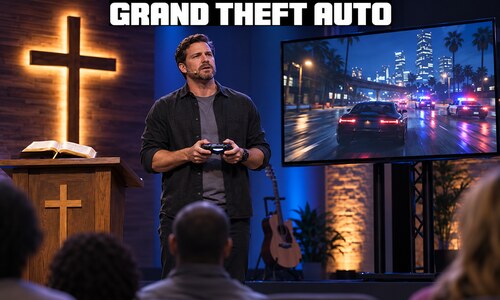
That distinction matters after Tyler Sterban, co-pastor of Different Church in Nashville, brought a television and game console onto the stage and played Grand Theft Auto 6 during a sermon. His point was about waiting: people had anticipated the game for years, he said, so why not wait on God with the same confidence?
The comparison is easy to understand. But it also creates a jarring moment. Sterban said the game is not appropriate for people to play, yet the congregation watched him play it onstage. He also said a staff member or friend spent $100 on the game as a “sacrifice for the ministry.”
As the game continued, Sterban acknowledged from the stage that he did not know what would happen next on the screen and said they had better cut it after it had been playing for a while. With a game rated for violence, language, nudity and sexual content, letting it run in the background without knowing what might appear was foolish. It also undercut the effort to use the game as a controlled illustration.
This is not an argument that sermons must be plain or that pastors should never use props. Jesus taught through stories drawn from everyday life. A vivid illustration can open a listener’s mind. The question is whether the image carries the truth—or whether it starts competing with it.
When shock takes over
In 2022, Pastor Michael Todd of Transformation Church acted out Jesus’ healing of a blind man by spitting mucus and saliva into his hands and rubbing it on his brother’s face. The illustration was meant to show that receiving God’s vision might get “nasty.” The congregation reacted with disgust, and the clip spread widely. Todd later called the illustration disgusting, said it had crossed a line and apologized for distracting from the message.
Two years later, Todd used another striking object lesson: he poured syrup and sprayed whipped cream over a Bible and communion elements while teaching about caring for the body as God’s temple. The point was that people can be protective of a Bible or church setting while neglecting their own health. But once again, the spectacle invited its own debate: Was the visual clarifying the teaching, or was it provoking a reaction that overshadowed it?
The difference between a memorable illustration and a distracting one is not simply whether people are shocked. It is whether the shock helps them grasp the truth—and whether the method treats the people and symbols involved with care.
When the illustration gets dangerous
In 2025, Philip Thornton, founding pastor of Legacy Faith Church in Pennsylvania, used an unloaded rifle to illustrate “spiritual violence against unbelief.” During the sermon, he pointed it toward congregants. Church leaders said the weapon had been disabled and cleared. But gun-safety experts criticized the demonstration, noting that a pastor could make the same point without aiming a weapon at church members.
The problem was not just that the image was dramatic. A gun pointed toward an audience carries a meaning of its own. Even if the weapon is unloaded, the pastor has introduced real fear and risk into a place where the congregation should be able to listen without wondering whether a stunt is safe.
Other pastors have chosen spectacle without the same danger. Bartholomew Orr of Brown Missionary Baptist Church entered the sanctuary on a zip line during a sermon about being ready for Jesus’ return. Orr wanted to give the congregation a visual picture of Christ coming back. The entrance went viral, but the flying pastor became the image many people remembered.
In Boston, Pastor Matthew Thompson used a trampoline to illustrate needing God’s help to get over life’s hurdles. The trampoline slipped; Thompson landed on his head. He got up and continued preaching, and he later joked about the fall. Still, the viral clip turned an illustration about perseverance into a clip about a preacher’s crash landing.
When the platform becomes the promotion
Ed and Lisa Young of Fellowship Church took a different approach to teaching about marriage and sex. In 2012, they planned to spend 24 hours in a bed on the church roof, streaming conversations about intimacy and promoting their book and sermon series. Their stated aim was to get Christians talking more openly about sex within marriage.
The subject deserves thoughtful teaching. But a rooftop bed-in turned that teaching into an event designed to attract attention. It raises a fair question for any pastor: when does a vivid way to teach become a promotional spectacle?
An illustration should carry the message
The Bible is full of images, stories and memorable comparisons. But Jesus’ parables did not need the listener to forget the lesson in order to remember the storyteller. The image served the truth.
Pastors should ask a few simple questions before building a sermon around a stunt: Does this help people understand the Scripture? Does it honor the people involved? Could the same truth be communicated without creating confusion, embarrassment or avoidable risk? And if the clip goes viral, will viewers remember the biblical point—or only the spectacle?
The GTA sermon may have been intended to teach patience and trust in God. Yet playing a game the pastor himself described as inappropriate—and letting it run while admitting he did not know what might appear—risks blurring the very point he wanted to make. The same tension appears in all these examples: a powerful illustration can open the door to a truth, but it can also draw every eye toward itself.
The pulpit does not need to be dull. It does need to keep the main thing in view. When the prop, performance or stunt becomes the sermon’s most unforgettable feature, the illustration may have done its job too well—and the message may have been left behind.