
215,000,000 Christians Persecuted, Mostly By Muslims
 By Raymond Ibrahim/Gatestone Institute January 26, 2018
Share this article:
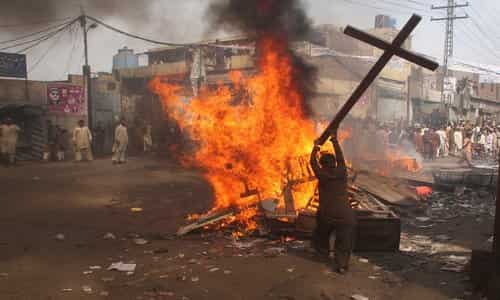
"215 million Christians experience high levels of persecution" around the world, according to Open Doors, a human rights organization. On its recently released World Watch List 2018, which ranks the world's 50 worst nations wherein to be Christian, 3,066 Christians were killed, 1,252 abducted, and 1,020 raped or sexually harassed on account of their faith; and 793 churches were attacked or destroyed.
The Islamic world had the lion's share of this persecution; 38 of the 50 worst nations are Muslim-majority. The report further cites "Islamic oppression" behind the "extreme persecution" that prevails in eight of the 10 worst nations.
In short, the overwhelming majority of persecution that these 215 million Christians experience around the world -- especially the worst forms, such as rape and murder -- occurs at the hands of Muslims.
These Muslims come from all walks of life and reflect a variety of races, nationalities, languages, socio-economic and political circumstances. They include Muslims from among America's closest allies (Saudi Arabia #12 worst persecutor) and Muslims from its opponents (Iran #10); Muslims from rich nations (Qatar #27 and Kuwait #34) and Muslims from poor nations (Afghanistan #2, Somalia #3, and Yemen #9); Muslims from widely recognized "radical" nations (Pakistan #5), and Muslims from "moderate" nations (Malaysia #23 and Indonesia #38).
But if the World Watch List ranks North Korea -- non-Islamic, communist -- as the number one worst persecutor of Christians, why belabor the religious identity of Muslims? Surely North Korea's top spot suggests that Christian persecution is not intrinsic to the Islamic world but is rather a byproduct of repressive regimes and other socio-economic factors that proliferate throughout the Muslim world?
There are some important distinctions that need to be made. While Christians are indeed experiencing a "life of hell" in North Korea, overthrowing Kim Jong-un's regime could not only lead to a quick halt to this persecution but also to a rise of Christianity -- as has happened recently in Russia.
Under the Soviet Union, between 12 and 25 million Christians were killed for their faith, and approximately 153,000 churches were shut down. Since the fall of the Soviet Union in 1991, about a thousand churches have been (re)built every year, and, according to a 2014 Pew report, between 1991 and 2008, Russians identifying themselves as Orthodox Christian rose from 31% to 72%. That "South Korea is so distinctively Christian" reflects what could be in store -- and creating fear for -- its northern counterpart.
In the Islamic world, the fall of dictatorial regimes rarely seems to alleviate the sufferings of Christians. On the contrary, when secular dictators fall -- Saddam in Iraq, Qaddafi in Libya, and attempts against Assad in Syria -- persecution of Christian seems to rise as a grassroots byproduct.
Today, Iraq is the eighth worst nation in the world in which to be Christian, Syria is fifteenth, and Libya seventh. Under dictators, these countries were significantly safer for religious minorities.
Similarly, the only countries that were part of the former Soviet Union that still persecute Christians are, rather tellingly, the Muslim-majority ones of Central Asia. These include Uzbekistan (#16 worst persecutor), Turkmenistan (#19), Tajikistan (#22), Kazakhstan (#28) and Azerbaijan (#45).
The "extreme persecution" of Christians throughout the Muslim world is part of a continuum begun nearly fourteen hundred years ago. The same patterns of persecution are still prevalent -- including attacks for blasphemy and apostasy, restrictions and attacks on churches, and a general contempt for -- followed by the vile treatment of -- "subhuman infidels."
Unlike the persecution of Christians in Communist nations, rooted to a particular regime, Muslim persecution of Christians is perennial, existential, and far transcends any ruler or regime. It unfortunately seems part and parcel of the history, doctrines, and socio-political makeup of Islam -- hence its tenacity and ubiquity. It is a "tradition."
That those persecuting Christians come from a wide variety of racial, linguistic, cultural, and socio-economic backgrounds -- from African, Arab, Asian, and Caucasian nations -- and share little in common with one another, except for Islam, sadly only further underscores the true source of the persecution.
If time is on the side of Christians living under Communist regimes, it is not on the side of Christians living under Islam. The center of the great Christian Byzantine Empire is now an increasingly intolerant, Islamizing Turkey.
Carthage, once a bastion of Christianity -- where one of Christendom's greatest theologians, St. Augustine, was born and where the New Testament canon was confirmed in 397 -- is today 99% Muslim-majority Tunisia. Centuries of persecution and forcing non-Muslims to live as barely-tolerated third-class residents are responsible for the demographic shift that Tunisia and other formerly non-Muslim nations are experiencing.
Long after North Korea's Kim Jong-un has gone, tens of millions of Christians and other "infidels" will still suffer persecution. As what began in the seventh century comes closer to fruition and the entire world becomes more Islamic and "infidel" free, as in Iraq, confronting these uncomfortable facts is at least a welcome first step in countering the problem.
Originally published at Gatestone Institute - reposted with permission.