
Has Time Finally Run Out For Tehran’s Islamist Tyrants?
 By Jonathan Tobin/JNS.org January 08, 2026
Share this article:
For the past 16 years, the world has continued to ask the same question with respect to the Islamist regime in Iran: Is it finally time for the despotic rule of the ayatollahs to end? Yet hopes that Iran might finally free itself have continually been disappointed. That's why even amid the heightened expectations that the breaking point has been reached, optimism about its imminent fall should remain tempered.
The theocracy imposed on the country in 1979--when the government of Shah Reza Pahlavi collapsed and was replaced by the rule of religious extremists, led by the Ayatollah Ruhollah Khomeini--has survived every previous challenge. Despite its manifest unpopularity, it has repeatedly been able to mobilize both the Islamic Revolutionary Guard Corps and the nation's army to suppress protests with the sort of deadly force that intimidated a restive population into sullen acceptance of their fate.
Nevertheless, the Islamist government's inability to effectively run a country rich in natural resources but now facing shortages of energy and clean water, as well as having wasted massive sums of money on building a nuclear program at home and funding terrorism abroad, has once again brought it to the brink.
Trump's threats
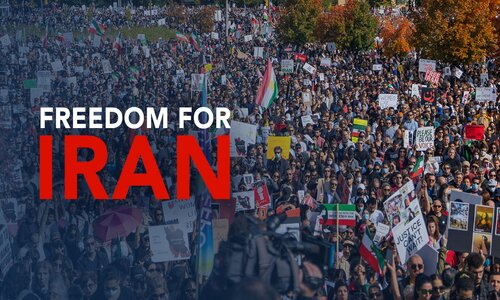
Speculation that the time has finally arrived for the fall of Iran's theocratic government is centered on the latest round of protests spreading throughout the country. An Iranian dissident site, the Human Rights Activists News Agency, reported on Jan. 6 that after 10 days of demonstrations, 34 protesters had been killed and more than 2,000 had been arrested in 285 separate anti-regime rallies.
Unlike in the past, such as in 2009, when massive protests occurred, and in the fall of 2022, when women took to the streets after the death in police custody of 22-year-old Mahsa Amini, the United States isn't signaling its passive support for the tyrants of Tehran. Under President Barack Obama, who was already planning a campaign of appeasement of the regime that would lead to the disastrous 2015 Iran nuclear deal and failed to speak out in support of the demonstrators, President Donald Trump has left no doubt about where the United States currently stands on the issue of Iran's future.
He warned that American armed forces are "locked and loaded," and ready to intervene. "If they start killing people, like they have in the past, I think they're going to get hit very hard by the United States," Trump said last week.
Given that the United States took part in a joint air campaign with Israel last June to take out Iran's nuclear facilities, neither the Iranians nor anyone else should regard that as an idle boast or typical Trumpian braggadocio. Over the weekend, Trump sent in American forces to capture Venezuelan dictator and narco-terrorist Nicolás Maduro and bring him back to the United States to face justice.
That should have further concentrated the minds of Iran's leaders on the prospect of what happens to deposed tyrants. If they don't make it to safety in friendly countries, their fate could be even less pleasant than that of Maduro. While none of them are currently under an American indictment, the reports that Iran's Supreme Leader, Ayatollah Ali Khamenei, has already planned to escape to Moscow with his family and aides should the regime's forces fail to quell the protests. That's a sign that they understand that their continued grasp on power is not guaranteed.
The problem, though, is that the ayatollahs and the leaders of the IRGC are acting like they do plan to hold on. And the explanation for their strategy should sober up optimists who, not for the first time, are already making bold predictions about what a new Iran would look like and who might govern it.
Iron rules of history
The Iranian regime is still dangerous for three important reasons that separate it from historical examples of past tyrannical regimes that collapsed, such as that of France's monarchical ancien regime in 1789 or the Soviet Union in 1991. Unlike those governments, many, if not most, of those who serve Iran's theocracy are still ardent believers in the Islamist faith that has been its guiding force for the last 46 years.
It's also true that, unlike the ayatollah, most of them don't have anywhere that they can flee to while holding on to their assets. As a result, the regime's henchmen--both in the IRGC and the army--seem willing to obey orders and kill as many of their compatriots as is necessary to once again stamp out hopes for freedom.
It remains an iron rule of history that tyrannies do not end because they are brutal. They collapse when they are no longer able to count on their loyalists to be brutal. They only fall when they are either conquered by external forces (i.e., Nazi Germany or Imperial Japan) and/or experience military defeat that destroys their credibility (i.e., the junta in Argentina after its failed 1982 invasion of the Falkland Islands). Or they go down after suffering a collapse of faith in a regime's legitimacy and belief system, as in the case with France in 1789, and Moscow's evil empire after the fall of the Berlin Wall and the dissolution of the Soviet Union.
Is such a crisis of faith happening in Tehran? It's hard to know for sure.
Their defeat at the hands of Israel and the United States, when their planes had free rein over Iran's skies as they sought out its nuclear and other targets, might turn out to be a tipping point. That was a body blow to a government that only a few years ago seemed well on its way to achieving regional hegemony with clients in power in Iraq, Syria, Lebanon and part of Yemen. The Israeli rout of Tehran's Hezbollah auxiliaries in 2024 was an unexpected setback for a terrorist force that for years seemed to be invincible in Southern Lebanon. That, in turn, led to the end of the Bashar Assad regime in Syria in December 2024, a nation that seemed to be in Iran's pocket up until then.
Add to that the growing economic collapse of the country, and it's hard to see how a government that still sees itself as an expression of Islamist revolution can cling to power.
Yet while the casualty figures from anti-regime protests and the claims that demonstrators are prevailing in some parts of the country are a potential sign of regime collapse, the fact that army and IRGC forces are still firing on dissidents and killing dozens could indicate that the regime's taste for blood and their ability to shed it have not slackened.
Moreover, despite the encouragement they're getting from Washington and Jerusalem, Iran's protesters should be under no illusion that this time, the Americans or Israelis will do their fighting for them.
Trump's tough talk notwithstanding, implementing threats in South America, which is in Washington's backyard, is a far cry from doing so in the Middle East. Trump might order some airstrikes on regime targets, but he's not going to make the mistake of engaging in an invasion that might lead to American occupation of part of Iran. Trump wants to use U.S. military force to make the Iranians pay a high price for bloody repression and continuing to spread terror. He has no interest in occupying the country or replicating the mistakes made in Iraq and Afghanistan during the long wars there that Americans grew tired of.
The Iranians must do it
If the rule of the ayatollahs is to end, it will require at least some of the Iranians with guns--in either the IRGC or the army--to turn them on their rulers. Americans, and even Israelis, might be prepared to help them become free. However, they are going to have to do most, if not all, of the hard and likely bloody work of overthrowing the theocrats themselves.
As illogical as it may be for an incompetent government that turned a rich land into a failed state to be able to hold onto power, Khamenei and his followers could do so if enough of their minions are still ready to slaughter more innocents demonstrating for freedom.
So, while Americans should be doing everything possible to encourage Iranians to throw off their shackles and rejoin the international community, it's by no means a certainty that this is going to happen or that even American assistance will make it a realistic possibility.
That's a discouraging thought for those who recognize just how dangerous Iran has become, both because of its status as a threshold nuclear power (or, at least, it was until last June) and its being the world's leading state sponsor of terrorism. Still, if Iranian opponents of the theocracy can't find a way to persuade at least some of the regime's enforcers to lay down their arms, then all the optimism about the end of the long Islamist nightmare will prove unfounded.
Originally published at JNS.org





