Trump Is The Pressure Point For Europe To Unite - Another Prophetic Footprint?
 By PNW Staff January 31, 2026
Share this article:
At an emergency summit of European Union leaders in Brussels, the building blocks of a new continental order were quietly taking shape. Europe is no longer debating abstract ideals; it is actively pursuing the foundation of a "super Europe" -- bigger, stronger, and capable of standing independently in a world dominated by unpredictable powers.
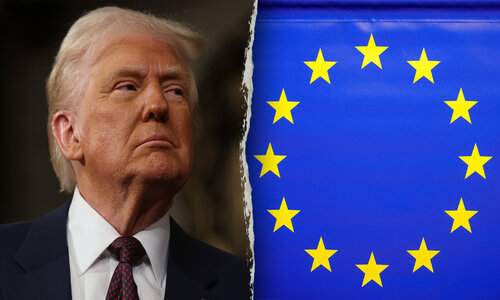
The driving force behind this transformation is unmistakable: Donald Trump. His blunt, transactional approach to diplomacy -- demanding greater burden-sharing, questioning alliances, and challenging long-standing norms -- exposed Europe's vulnerability. For decades, the continent relied on American guarantees for security, trade, and stability. Trump stripped away that assumption, forcing Europe to confront a stark reality: dependence is a risk.
"This is not a cosy place," German Chancellor Friedrich Merz said in Davos, describing a global order changing at an "unprecedented pace." "Europe has got the message," he added, promising an ambitious reform agenda centered on security, competitiveness, and unity. A day after the summit, Merz signed an accord pledging close coordination with Italy's Giorgia Meloni, signaling that Europe's two most influential leaders are aligned in their vision of integration.
European Commission President Ursula von der Leyen acknowledged the challenge: "We know we have to work for a more independent Europe. This is not something which happens overnight. This is hard work." Danish Prime Minister Mette Frederiksen reflected on the continent's newfound cohesion: "When Europe is not divided, when we stand together, and when we are clear and strong...results will show. I think we have learned something in the last days and weeks."
Enlargement is central to Europe's new strategy. Nine nations are now knocking at the EU's door. Montenegro and Albania are closest to accession, while North Macedonia, Kosovo, Bosnia and Herzegovina, and Serbia are waiting in line. Moldova and Georgia applied following Russia's invasion of Ukraine, and Iceland could hold a referendum on membership -- partly as protection against U.S. assertiveness. Belgian Prime Minister Bart De Wever explained: "People want to join the European Union. Nobody wants to join China. No neighbour of the United States wants to join the United States. Because we have respect, we have the rule of law. We do speak softly."
If the EU incorporates the Balkans, Moldova, Georgia, Ukraine, and Iceland, its territory could expand by almost 400,000 square miles, and its population could swell by 57 million. A European official emphasized: "In this new world, size matters. It will make our single market larger, it will bring stability and security." To achieve this, Brussels envisions a "multi-speed Europe," bending old integration rules and creating a flexible structure where nations like Britain could maintain close ties without full membership.
Trump's pressure accelerated this transformation. By forcing Europe to defend its own interests, he has spurred initiatives that might otherwise have taken decades. Europe's response -- enlargement, centralization, and strategic autonomy -- reflects a continent awakening to its own potential power, almost unintentionally.
Europe's strengths make this ambition plausible. Its single market rivals the United States in scale, its regulatory authority shapes global commerce, and military spending is rising. Yet Europe's weaknesses remain: cultural fragmentation, economic unevenness, and political divisions. Centralized authority is proposed as the solution -- fewer vetoes, faster votes, and tighter compliance.
And here is where history and prophecy converge. For centuries, scholars have identified Europe as the heir to the ancient Roman Empire. The prophet Daniel envisioned a final kingdom symbolized by a statue whose ten toes were "partly iron, partly clay" -- strong yet fragile, united yet fractured. Revelation describes a coalition of nations that ultimately consolidates power under a single leader. From the Holy Roman Empire to modern EU institutions, the impulse to unify Europe under centralized authority has repeatedly resurfaced, especially in moments of crisis.
Many theologians believe the Antichrist will emerge from this framework -- not as a chaotic revolutionary, but as a polished political figure offering order amid instability, peace amid fear. Ironically, in reacting to external pressure from leaders like Trump, European elites are accelerating the centralization of power -- reducing national sovereignty, sidelining dissenting states, and empowering supranational institutions in ways that align uncannily with the prophetic vision.
This is not to suggest Europe's ambitions are inherently sinister. Cooperation can prevent war, and collective defense can deter aggression. But history shows that empires rarely remain purely administrative. Power centralizes. Crisis justifies control. Leaders arise who promise salvation -- at a cost.
Trump did not create Europe's imperial instinct. He exposed it. By stripping away the illusion of guaranteed American backing, he forced Europe to choose between dependence and dominance. Europe has chosen to integrate -- rapidly, deliberately, and with growing confidence.
Whether this transformation becomes a force for stability or sets the stage for the darker currents of history and prophecy remains uncertain. One thing is undeniable: Europe is no longer merely a participant in world affairs. It is preparing to rule within them.