
Big Surprises In The 2030 Census Estimates - America's Changing Demographics
 By Michael Barone/Daily Signal February 02, 2026
Share this article:
About a month late, presumably due to last fall's government shutdown, the Census Bureau has released its estimates of the populations of the 50 states and the District of Columbia for July 1, 2025.
It provides an interesting picture of what the country is, and is becoming, halfway through the decade of the 2020s and one-quarter of the way through (have we really gotten this far?) the 21st century. It also provides some political dynamite, all the more explosive because of Census Bureau statisticians' deserved reputation for apolitical rigor and willingness to admit mistakes, as it did on the COVID-19-plagued 2020 census.
The headline story is the sharp rise and sharp fall in immigration. The notion that immigration exploded sharply during the Biden administration and contracted sharply during the second Trump administration is not political propaganda.
After the expiration of most COVID-19 restrictions, immigration rose to 1.8 million in 2021-22, 2.6 million in 2022-23, and 3.2 million in 2023-24.
The snapback to 1.9 million in 2024-25 reflects changes in both outgoing and incoming administrations. With the election looming, the Biden administration in early 2024 discovered that current legislation let it restrict immigration in ways it had claimed it didn't before, and under the same legislation, the Trump administration immediately stopped almost all illegal border crossings. Government policy can make a difference.
Taking that into account, the Census Bureau estimates immigration will fall well below 500,000 in 2025-26. That's comparable to the sharp falloff of immigration during the financial and economic crises of 2007-08.
That means the nation's total population increase is sharply down, especially in the states centered on the nation's four largest metropolitan areas, which either grew just barely (New York and Illinois) or lost population (California). Meanwhile, every state in the Midwest gained population, and five states grew above the national rate.
Even more striking, 44% of the nation's population gains in 2020-25 came in just the two states of Texas and Florida. When you add in North Carolina, Georgia, Arizona, South Carolina--with the nation's higher percentage growth in 2024-25--and Tennessee, you have 70% of the total national popular gain, all in states carried by Donald Trump in 2024.
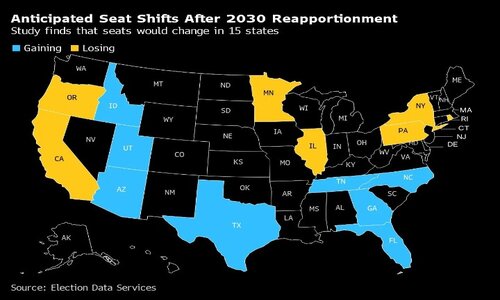
Projecting 2020-25 or 2024-25 patterns ahead of the 2030 census and the reapportionment of U.S. House seats among the states that automatically follows results in a sharp change of political balance. Two different projections have California losing four House seats and Texas gaining four, leaving California with 48, only marginally larger than Texas' 42.
One has Florida gaining four and New York and Illinois losing two each, while the other has Florida gaining two and New York and Florida losing one each, with the same net partisan effect. There is agreement that five more or less Republican states will gain one seat each (Georgia, North Carolina, Arizona, Utah, and Idaho) and that five more or less Democrat states will lose one each--Rhode Island, Pennsylvania, Wisconsin, Minnesota, and Oregon.
Apply either set of projections to the 2024 presidential election totals, and Trump gains either nine or 11 electoral votes--and wins even if he loses his three closest states, Wisconsin, Michigan, and Pennsylvania. The blue wall has become a purple flowerbed.
That doesn't mean Democrats will be frozen out of the White House. Changes in opinion of a magnitude often experienced can render the 2024 numbers obsolete. But one can see difficulties, even in 2028, if Democrats nominate one of the two California politicians, Gov. Gavin Newsom or former Vice President Kamala Harris, who top their polls. Will the nation be well served by policies that have prompted more people to leave than to head to a state with California's beautiful scenery and comfortable climate?
It's harder to be sure whether the 2030 census will give Republicans a boost in Congress. The current ructions over mid-decade redistricting make prediction perilous. An intermediate court has blocked Virginia Democrats from gerrymandering, and a trial judge has ruled that the Voting Rights Act requires linking a Staten Island-dominated district to Manhattan rather than Brooklyn.
But almost certainly any political redistricting would rather be a Republican adding multiple districts in Texas and Florida than a Democrat required to eliminate some of his party's incumbents in California, New York, or Illinois. And heavily Democrat central cities will no longer be entitled to as much representation from masses of illegal immigrants protected from deportation but counted by census takers.
A final caveat. Issues aren't static, politicians aren't around forever, and voters move around amid changes in the political landscape. The Trump era has been full of surprises--who thought he'd win in 2024 because of increased Latino support?--and the 2030s, when Trump won't be president nor be running for president, will have its surprises for us too.
Originally published at The Daily Signal