
The Northern Front: Why Israel May Soon Take The War Into Lebanon
 By PNW Staff March 16, 2026
Share this article:
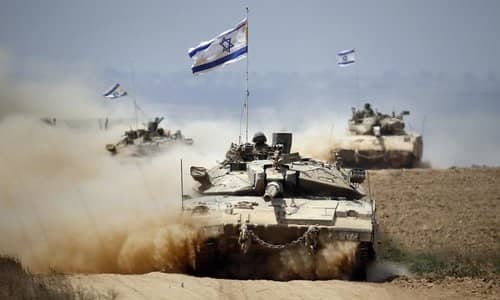
For months, Israel's northern border has lived under the constant threat of rockets, drones, and missiles fired by Hezbollah. But in recent days, something has changed in the tone coming from Jerusalem. Israeli leaders are no longer speaking merely about retaliation or deterrence. They are speaking about control, security zones, and the possibility of taking the fight directly into Lebanon.
For many Israelis--and for those who support Israel around the world--the shift feels less like escalation and more like inevitability.
Hezbollah has launched its largest rocket barrages since the current phase of the war began, including coordinated attacks that Israeli officials say involved Iranian participation. Hundreds of rockets have targeted communities across northern Israel, sending civilians rushing into shelters and forcing daily life to halt in towns that have already endured more than a year of instability.
Israel's response has been swift and increasingly decisive. Defense Minister Israel Katz announced this week that he and Prime Minister Benjamin Netanyahu have instructed the Israel Defense Forces (IDF) to prepare for expanded military operations in Lebanon if Hezbollah's attacks continue.
Katz's warning was blunt: if Lebanon cannot stop Hezbollah, Israel will.
"If the Lebanese government fails to prevent Hezbollah rocket and drone attacks on Israel, we will take control of the territory and do it ourselves," he said.
That statement is not simply rhetoric. It reflects a growing consensus within Israel that the status quo along the northern border has become intolerable.
The Broken Ceasefire
After the devastating events of October 7 attacks, Israel spent more than a year fighting Hamas in Gaza while simultaneously enduring Hezbollah attacks from Lebanon. Entire Israeli communities near the border were evacuated for safety, leaving towns that once bustled with families eerily empty.
A U.S.-brokered ceasefire in late 2024 was supposed to bring stability. Under that agreement, Hezbollah forces were expected to withdraw from southern Lebanon while the Lebanese Armed Forces moved in to enforce the arrangement.
But the agreement never fully materialized.
Hezbollah remained entrenched. Missile launchers stayed hidden in villages and hillsides. Drone attacks continued. And Israeli intelligence reports suggested that the Iranian-backed terror group was expanding its capabilities rather than dismantling them.
Now Israeli leaders say the patience of the Israeli public--and the Israeli military--has run out.
"The conclusion is always that what we do not do, no one else will do," Katz said this week, pointing to Lebanon's failure to enforce the ceasefire or disarm Hezbollah.
From Israel's perspective, the situation has become a textbook example of why security cannot be outsourced to international promises.
Hezbollah's Calculated Gamble
Hezbollah, for its part, appears prepared for escalation.
Its leader, Naim Qassem, has openly declared that the organization is ready for a long war, framing the conflict as an "existential battle."
The group has already suffered heavy losses. Israeli officials say more than 380 Hezbollah operatives--including key commanders--have been killed since the start of the current campaign known as Operation Roaring Lion. Israeli forces have also targeted hundreds of missile launchers, command centers, and infrastructure sites across Lebanon.
Yet Hezbollah continues firing.
Why?
Because from Iran's perspective, Hezbollah is not merely a Lebanese militia. It is Tehran's most powerful proxy army--an advanced missile force positioned directly on Israel's northern border.
For Iran, Hezbollah serves as both shield and sword.
And that makes the northern front one of the most dangerous flashpoints in the entire Middle East.
Why Israel May Invade
For Israel, the strategic logic behind a possible invasion of southern Lebanon is increasingly clear.
First, Hezbollah possesses an estimated arsenal of tens of thousands of rockets and missiles capable of reaching deep into Israeli territory.
Second, the group has built extensive tunnel networks, fortified villages, and hidden weapons depots near the border.
Third--and perhaps most importantly--Israel has already experienced the consequences of ignoring a growing terror threat.
October 7 changed Israeli strategic thinking permanently.
The doctrine of waiting and containing is now viewed by many Israelis as dangerously naïve. If an enemy openly declares its intention to attack and builds the infrastructure to do so, Israel increasingly believes it must strike first.
That is why discussions in Israeli military circles increasingly center around pushing Hezbollah forces north of the Litani River, creating a deeper buffer zone that would protect Israeli border towns from direct attack.
Reports suggest that Israeli planners are considering precisely such an operation if rocket fire continues.
The Lebanese Government's Impossible Position
Lebanon itself finds itself trapped in a tragic paradox.
The country's official government does not fully control Hezbollah, yet it bears international responsibility for the group's actions.
Even Lebanese President Joseph Aoun has acknowledged the destabilizing role Hezbollah plays, warning that its actions risk collapsing the Lebanese state and dragging the country into catastrophe.
But Lebanon's weak government lacks the military power to confront Hezbollah directly.
That leaves Israel facing a grim calculation: if Beirut cannot remove the threat, Israel may feel compelled to do it itself.
The Road Ahead
For Israel, the stakes are not theoretical.
They are personal.
They are the families in Kiryat Shmona who cannot return home.
They are the farmers who cannot safely work fields near the border.
They are the children who have spent more time in bomb shelters than playgrounds.
Israel has made it clear: this time there will be no mass evacuation of northern communities.
Instead, the threat will be pushed back.
Whether that requires deeper airstrikes, expanded operations, or a full-scale invasion of southern Lebanon remains to be seen.
But one thing is increasingly clear.
Israel's leaders believe that the security of their people cannot depend on broken promises or unenforced ceasefires.
And if Hezbollah continues its attacks, the next phase of this war may not be fought from across the border.
It may be fought inside Lebanon itself.