
Gen Z Is The Least Christian Generation In America - But There Is Still Hope
 By PNW Staff May 19, 2026
Share this article:
For generations, America's cultural identity was deeply tied to Christianity. Churches shaped communities, biblical literacy was common, and even those who did not actively practice the faith often understood its moral foundations. But with Generation Z, something historic has changed.
According to new research from the Cultural Research Center at Arizona Christian University, Gen Z is now the least Christian generation in American history -- and by a staggering margin.
The findings are sobering.
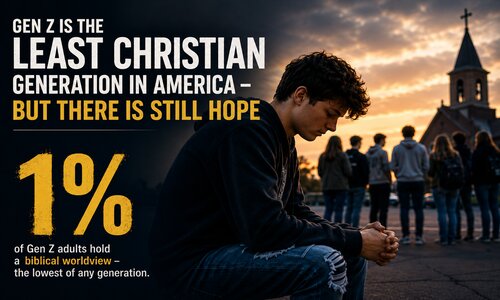
Research led by longtime Christian researcher George Barna found that just 1% of Gen Z adults hold a biblical worldview. Not 10%. Not even 5%. One percent.
That number alone should send shockwaves through churches, parents, and Christian leaders across the country. It is not merely a sign of declining church attendance or shifting cultural preferences. It reflects something deeper: a generation increasingly disconnected from the foundational truths of Christianity itself.
And the evidence goes far beyond labels.
The report found a 15-point increase in the number of Gen Z adults who believe Jesus Christ sinned while on Earth -- a direct contradiction of one of Christianity's most foundational doctrines. Researchers also documented a 13-point increase among young adults who say they regularly receive helpful guidance from horoscopes, while belief in absolute moral truth continues to erode, with a 10-point rise in those who say there is no absolute moral truth at all. There was also a six-point increase in the number of Gen Z adults who say there is no life after death.
At the same time, support for biblical marriage continues to erode. Researchers documented an 18-point increase among Gen Z adults who now believe traditional marriage between one man and one woman is merely one lifestyle option among many rather than God's design for humanity.
These are not isolated statistics. Together, they paint a picture of a generation shaped less by Scripture and more by social media, celebrity activism, political ideology, and internet spirituality.
Perhaps most alarming is how quickly the shift is accelerating.
According to the report, support among Gen Z adults for socialism over capitalism jumped from 22% to 39% in just four years. That statistic is not merely economic; it reflects a broader worldview transformation. Many younger Americans increasingly look to government, activism, or digital communities to provide meaning, identity, and salvation-like solutions once rooted in faith and family structures.
And yet, despite all this, there remains a growing conversation about whether revival may still be emerging among young people.
In recent months, stories of spiritual curiosity among Gen Z have made headlines. Viral moments involving public figures discussing faith, rising Bible sales among younger demographics, and renewed interest in Christianity on college campuses have sparked cautious optimism among believers. Some pointed to spiritual discussions following the assassination of conservative commentator Charlie Kirk as evidence that young Americans may be searching for deeper meaning in an increasingly unstable world.
But Barna's research urges caution against overstating the trend.
"The research gives a lukewarm affirmation of revival, at best," researchers concluded. While there are "tepid signs" of spiritual openness, there is little evidence yet of a broad national movement of repentance and biblical transformation among Gen Z.
That distinction matters.
America has often mistaken emotional moments for revival. A viral worship service, a trending Christian influencer, or a spike in Bible interest does not automatically mean hearts are truly being transformed. Biblical revival is not measured merely by excitement, but by repentance, conviction, holiness, and lasting worldview change.
And according to the current data, that deeper transformation has not yet taken root on a large scale.
Still, Christians should not fall into despair.
The Bible repeatedly shows God working through remnants. In nearly every era of spiritual collapse, God preserved a faithful minority through whom He accomplished mighty things. From Elijah believing he stood alone against the prophets of Baal, to the small band of disciples who carried Christianity across the Roman world, Scripture is filled with examples of God using what appeared weak, outnumbered, or culturally insignificant.
In many ways, that may now describe faithful young Christians in America.
For perhaps the first time in modern U.S. history, truly biblical Christianity among young people is becoming countercultural. Standing for biblical truth on sexuality, morality, marriage, or the authority of Scripture increasingly comes with social cost. In schools, online spaces, workplaces, and even some churches, Gen Z Christians often face immense pressure to compromise.
Yet history also shows that cultural darkness can create spiritual hunger.
Many Gen Z young adults have grown up in a world marked by anxiety, loneliness, broken families, pornography addiction, political chaos, economic uncertainty, and digital overload. They were promised that self-expression, technology, and limitless personal freedom would bring fulfillment. Instead, many are experiencing confusion, isolation, and despair.
That spiritual emptiness may ultimately become the very thing God uses to awaken hearts.
But revival will not happen automatically.
Barna warned that without intentional discipleship, the outlook remains grim. Church attendance alone is not enough. Emotional worship experiences alone are not enough. Young people must understand why biblical truth matters and how it shapes every area of life.
"Without making the connection between beliefs and behaviors," Barna warned, "individuals are likely to revert to prior, comfortable habits."
That may be one of the Church's greatest failures over the last several decades. Too often Christianity was reduced to routines, entertainment, or vague moralism instead of deep discipleship rooted in Scripture. Many young people inherited religious habits without biblical foundations strong enough to survive today's cultural pressures.
Now the consequences are becoming visible.
But even now, there is still hope.
Not because the trends are encouraging. They are not. Not because revival is clearly underway. It may not be. There is hope because throughout history, God has often done His greatest work precisely when circumstances appeared most hopeless.
The question is whether the Church is willing to recognize the seriousness of this moment before an entire generation slips even further away.