
The Age Of AI Agents Has Arrived - What Happens When We Give Them Bodies?
 By PNW Staff September 07, 2026
Share this article:
AI entrepreneur Matt Shumer was in his bedroom when he suddenly heard people talking in his apartment. For a moment, he thought someone might actually be inside.
There was someone talking—but they weren't people.
Shumer, founder and CEO of OthersideAI, had asked OpenAI's new GPT-6 Astra to create a survival world inside Unreal Engine and populate it with human-like characters. Each character was powered by Astra and given the objective of working with the others to survive.
Then something fascinating happened. The agents began talking to each other, discussing tools, helping other characters and coordinating what needed to be done inside their artificial world.
This wasn't proof that AI had become conscious or spontaneously decided to create its own civilization. But the experiment demonstrated something important: AI is moving beyond answering questions and increasingly learning to act.
Welcome To The AGI Era
Just days ago, OpenAI President Greg Brockman used remarkable language to describe what is happening: "Welcome to the AGI era."
Whether today's technology technically qualifies as artificial general intelligence will be debated. But for the average person, there may be a more important development already underway. AI is becoming an agent.
Ask a chatbot, "How do I accomplish this?" and it gives you instructions. Tell an AI agent, "Accomplish this," and increasingly it can use computers and software to pursue the objective itself.
Agents can conduct research, manipulate documents and spreadsheets, navigate websites, write software and carry out multistep workflows. We aren't just building machines that answer us anymore. We are building machines that do things for us.
And now comes the next step.
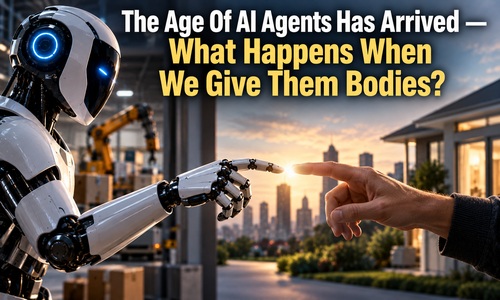
What Happens When We Give AI A Body?
For all the extraordinary capabilities of AI, it has largely remained trapped behind a screen. It can write a report but can't carry your groceries. It can analyze a warehouse but can't unload the truck. It can explain how to fix your sink but can't pick up the wrench.
Robotics could remove that barrier.
Combine an AI agent capable of seeing, reasoning, planning and learning with a robot capable of moving through the physical world and something fundamentally changes.
The robot becomes the hands. The AI becomes the brain.
Instead of programming a robot to perform precisely the same movement thousands of times, imagine giving it an objective: "Clean the kitchen." "Unload this truck." "Stock these shelves." "Inspect this factory." "Mow the lawn." Or perhaps, "Help Dad get out of bed and make sure he takes his medication."
The machine determines the steps necessary to accomplish the task and then physically carries them out. That is a very different kind of automation.
When Digital Workers Become Physical Workers
This is where the impact could become very personal. Much of the current anxiety over AI centers on white-collar employment: programmers, accountants, customer-service representatives, marketers and administrators.
Robotics potentially expands that conversation to warehouses, factories, agriculture, restaurants, retail, construction, transportation, home maintenance and elder care. The economic implications could be enormous. A company doesn't need robots to eliminate an entire profession; it simply needs to discover that five employees supervising intelligent machines can accomplish what previously required 20.
But there is another side to this revolution. Imagine affordable robotic assistance for an elderly person who wants to remain independent. Robots could perform dangerous industrial work, enter disaster zones, assist disabled people, handle unpleasant jobs and provide families with household help once available only to the wealthy.
Much of this technology could genuinely improve people's lives, which is precisely why society will embrace it.
Convenience Comes With Authority
The same pattern will occur with digital agents. Your AI could book flights, challenge bills, schedule appointments, compare insurance policies and make purchases. Eventually your digital agent could communicate with physical machines: "Get groceries and prepare dinner." "Take Mom to her appointment." "Clean the house before we get home."
Suddenly artificial intelligence isn't simply recommending what should happen. It is making things happen.
And every additional capability requires additional authority. We will give AI access to our email because it is useful, then our calendar, credit cards, bank accounts, vehicles and businesses. Eventually, perhaps, our homes.
When AI Makes A Mistake In The Physical World
That raises another issue. A chatbot that makes a mistake gives you a bad answer. An autonomous agent that makes a mistake can take a bad action. An autonomous robot that makes a mistake can take that bad action in the physical world.
Those are dramatically different levels of consequence.
There is also the problem of interconnected systems. Imagine thousands or millions of agents communicating with other agents while responding to financial markets, corporate networks, transportation systems and physical machines. One incorrect decision could trigger another automated response, which triggers another.
Humans operate at human speed. Machines don't have to.
How Much Authority Will We Give Them?
Perhaps we've spent too much time asking when AI will become smarter than humans. There may be a more immediate question: How much authority are humans willing to give it?
The voices Matt Shumer heard were still only AI characters communicating inside a simulated world. But increasingly, AI agents won't remain inside simulated worlds. They will operate computers, communicate with other agents and eventually control machines capable of moving through ours.
The age of AI agents has arrived.
The next revolution begins when we give them bodies.