
The Blackout Weapon: Could China Or Russia Turn Off America?
 By PNW Staff September 07, 2026
Share this article:
America's enemies do not necessarily have to destroy our cities to cripple the country. They may only need to make those cities stop functioning.
That uncomfortable reality is coming into focus as Iranian-linked hackers threaten attacks against America's energy, water and telecommunications infrastructure, while lawmakers are simultaneously raising alarms about the potentially much larger threat posed by electromagnetic pulse weapons.
The two threats are very different, but they expose the same weakness: modern America is extraordinarily dependent upon interconnected systems, and when one fails, it can begin pulling others down with it.
Iran's hackers are providing a timely reminder.
America's Infrastructure Is Already Being Targeted
A Telegram channel presenting itself as a voice for Iranian cyber operations recently issued an ominous warning: "Soon, the United States will witness unexpected and critical events in the energy, water, and telecommunications industries."
The threat comes as tensions between Washington and Tehran continue escalating. House Intelligence Committee Chairman Rick Crawford said Iran remains a persistent threat, particularly against America's critical infrastructure and cyber systems. Recent Iranian-linked attempts have reportedly targeted automated systems connected to the internet, although officials say the latest attacks have not produced major disruptions.
The danger is hardly theoretical.
CISA revealed in August that hackers had targeted more than 100 internet-exposed systems in America's water and wastewater sector during July. Federal agencies have separately warned about Iranian-affiliated actors exploiting programmable logic controllers used to operate physical machinery within critical infrastructure.
That should concern Americans, but hacking is only one potential method of attacking the systems upon which modern society depends.
There is another scenario that could be exponentially worse.
The Blackout Weapon
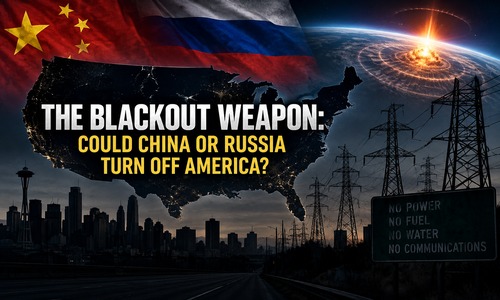
An electromagnetic pulse, or EMP, can be produced by a nuclear weapon detonated high above the Earth. Unlike a nuclear strike against a city, the primary objective would not necessarily be destroying buildings or killing people through the initial blast.
It would be attacking electronics and the electrical infrastructure supporting modern civilization.
Depending upon the weapon, altitude, location and other factors, electromagnetic effects could potentially disrupt electrical systems across an enormous geographic area. The Congressional Budget Office has previously noted that a high-altitude EMP could threaten telecommunications, transportation, food distribution, emergency response and banking in addition to the electrical grid itself, although experts disagree about the precise scale of damage that a particular attack would cause.
That uncertainty should not obscure the larger problem.
America has built an incredibly sophisticated society upon systems that increasingly cannot function without one another.
The Domino Effect
Imagine the electrical grid suffers widespread disruption.
The immediate problem is obvious: the lights go out.
But electricity is only the first domino.
Telecommunications require electricity. Cell towers have backup power, but batteries and generators do not operate indefinitely. Data centers, internet providers and communications networks begin encountering problems.
Water systems require electricity to operate pumps, treatment facilities and control systems. When power becomes unreliable, water pressure and treatment can eventually become unreliable as well.
Fuel distribution depends upon electricity and communications. Refineries, pipelines, terminals and gas stations require power. Even if millions of gallons of gasoline remain underground, motorists cannot simply access it when pumps do not work.
Transportation then begins suffering.
Without fuel, trucks cannot efficiently replenish grocery stores. Repair crews cannot easily reach damaged infrastructure. Emergency vehicles face logistical problems. Food warehouses and refrigeration systems require electricity, while stores increasingly struggle to process electronic payments.
Banking depends upon telecommunications and electricity. ATMs, credit-card processing, electronic banking and financial networks become increasingly difficult to access.
Hospitals have generators, but generators require fuel. Hospitals also depend upon functioning communications, water, pharmacies, medical suppliers and transportation networks.
The failure therefore moves through society like falling dominoes:
Power affects communications. Communications affect transportation and finance. Power and transportation affect water and fuel. Fuel affects transportation. Transportation affects food and medicine.
Then each failing system makes repairing the others more difficult.
CISA itself warns that critical infrastructure dependencies can produce precisely these "cascading" effects. Energy and communications, for example, can be mutually dependent, while electricity, communications, transportation and water are fundamental to practically every other critical infrastructure sector.
This is the part of the EMP threat that is often misunderstood. The greatest danger may not be what fails during the first minute.
It is what begins failing during the following days because something else failed first.
An Enemy Doesn't Have To Destroy America
China and Russia understand these vulnerabilities.
Any scenario involving a nuclear EMP attack would represent an extraordinary act of war and potentially invite devastating American retaliation. It should therefore not be portrayed as something Beijing or Moscow could casually undertake without consequences.
But military planners prepare for capabilities, not merely intentions.
The frightening strategic concept is remarkably simple: Why fight every component of the world's most powerful military and largest economy individually when attacking a handful of foundational systems could potentially create failures throughout the entire society?
Iranian hackers probing American infrastructure illustrate the smaller version of this strategy. Cyberattackers search for vulnerable control systems capable of producing physical consequences without ever dropping a bomb.
An EMP represents the nightmare version: a potential attempt to disrupt numerous systems simultaneously across a vast area.
America's Achilles' Heel
America has spent decades building the most technologically advanced society in human history. That technology has produced extraordinary efficiency, wealth and convenience.
It has also produced dependence.
Our food supply depends upon electricity. Our water depends upon electricity. Our communications depend upon electricity. Our financial system depends upon electricity. Our hospitals, fuel networks, transportation systems and emergency services all depend to varying degrees upon electricity and one another.
That interconnectedness is what makes modern America work so well.
It could also become our Achilles' heel.
Iran's cyber threats deserve attention. But the larger warning is what those threats reveal about the nature of modern warfare.
America has spent trillions preparing to defeat enemies on battlefields around the world. China and Russia may be forcing Washington to confront an entirely different question:
Are we equally prepared to keep the lights on at home?