An American 'Intifada'? BDS Tries To Hijack BLM
 By A.J. Caschetta/JNS.org June 8, 2020
Share this article:
Watching as a variety of actors, known and unknown, attempt to tear the United States apart at the seams has me thinking about the intifada, the Palestinian "uprising" against or "shaking off" of Israel. The protests" (riots?) in America have taken on some peculiarly Palestinian qualities.
While most Americans recoil in horror from the images they have been seeing, others are looking for ways to capitalize on the situation and win adherents to their side.
Chief among the latter is Hatem Bazian, a lecturer in the departments of Near Eastern and ethnic studies at the University of California, Berkeley. He is also the founder of Berkeley's Islamophobia Research and Documentation Project at the Center for Race and Gender, and a founder of Students for Justice in Palestine.
At an anti-America rally in San Francisco in 2014, he called for an uprising that "changes fundamentally the political dynamics," and asked, "How come we don't have an intifada in this country?"
The First Intifada was launched in 1987, the year that Hamas was established. Under the cover of protests and strikes, Palestinian leaders used children to confront Israeli soldiers with rocks. That uprising largely ended in 1993 with the Oslo Accords, but a second one was launched in 2000, and this time the weapon of choice was the suicide bomber. The Second Intifada ended in 2005. A third one, dubbed the "knife intifada," began in 2015.
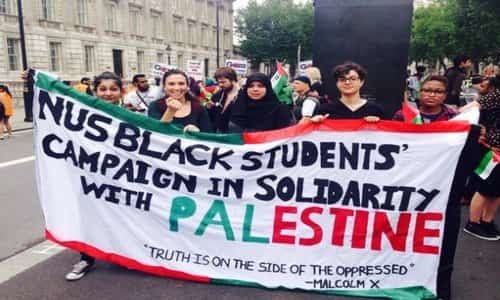
There are symbolic, tactical and rhetorical elements of the above uprisings evident in the current demonstrations in the United States. In addition to protesters carrying inverted American flags, there have also been pan-Arab flags, Black Liberation Army flags and Palestinian flags on display.
In addition, synagogues have been vandalized. Eyal Dahan, an Israeli living in Los Angeles, recently recounted seeing rioters with a "PLO flag ... shouting 'free Palestine,' " and said that he didn't believe black protesters were behind the damage.
The late PLO chief Yasser Arafat appealed to Western audiences by focusing on Palestinian victimhood at the hands of the Jewish state. What he didn't mention was that the PLO and the Black Panthers forged an alliance in the 1960s. Former Black Panther and Black Liberation Army member Dhoruba bin Wahad discussed that alliance in a 2014 interview.
Years later, a new idea called "intersectionality" was used to link the two movements. A quasi-Marxist ideology, replete with the binary division of "oppressed people" and their "oppressors," intersectionality seeks to link all suffering and oppressed people, and therefore also all of their oppressors, to each other.
As Jonathan Tobin explains, the idea makes "all Jews in Israel ... the moral equivalent of white European settlers in Africa," and equates "blacks who oppose systemic racism in America [with] Palestinians resisting Zionism."
This parallel was first articulated in 2014, when Ferguson, Missouri became "ground zero" for anti-police demonstrations. The riots erupted after Ferguson police officer Darren Wilson fatally shot African American Michael Brown. Following Brown's death, the official website of the boycott, divestment and sanctions movement (BDS) issued a statement expressing "deep solidarity with the African American community in Ferguson, Missouri."
The following year--when violence erupted in Baltimore, Maryland after the death of Freddie Gray in police custody--anti-Israel activists worked to connect the Israeli military to the Baltimore Police Department. American Jewish journalist and Hamas sympathizer Max Blumenthal blamed the police for adopting the Israeli's "brutal fighting style" and deploying an Israel Defense Forces "sound device used to disperse crowds."
For good measure, he later added, "Baltimore police use the Long Range Acoustic Device (LRAD): this device was tested on Palestinians."
Noted Palestinian activist Noura Erakat, a professor of Africana studies at Rutgers University specializing in international law, and an editorial committee member of the Journal for Palestine Studies, tweeted on April 27, 2015, "It's not a riot, it's an #intifada. #Baltimore #FreddieGray #BlackLivesMatter."
By the time George Floyd was killed more than five years later--on Monday, May 25--it was inevitable that his death would be manipulated by the BDS movement. The next day, the BDS and Palestine Solidarity "working group" of the Democratic Socialists of America tweeted that "the police violence happening tonight in Minneapolis is straight out of the IDF playbook ... US cops train in Israel."
On Thursday, May 28, the U.S. Campaign for Palestinian Rights tweeted: "The Israeli military trains U.S. police in racist and repressive policing tactics, which systematically targets black and brown bodies."
Later that day, Professor Erakat used Arafat's favorite euphemism by describing the rioters in Minneapolis as "freedom fighters in Minnesota."
On Friday, May 30, the BDS movement's primary Twitter account offered a rhyming chant: "We can't breathe until we're free! Palestinians stand in solidarity."
The Palestinian Authority also noticed an opportunity to propagandize an Israel connection to Floyd's death. The P.A. daily, Al-Hayat Al-Jadida, published a cartoon on June 1 depicting an IDF soldier kneeling on the neck of a keffiyeh-wearing man.
Next to him is a police officer in blue, with an American flag on his shoulder, kneeling on the neck of a black man. The soldier and police officer have their arms around each other, under a caption, in English, reading: "Black Lives Matter."
Palestinian protestors dutifully have adopted George Floyd as a symbol of their protests, comparing his death to that of Iyad Halak, a Palestinian on the autism spectrum, killed on May 30 by an Israeli police officer in eastern Jerusalem who mistook him for a potential terrorist. Such protesters have been waving signs reading, "Justice for Iyad, Justice for George."
In addition, Floyd's image superimposed on a Palestinian flag was painted on Israel's separation separation wall. Al-Monitor's Daoud Kuttab quotes numerous influential Palestinian Americans drawing parallels between a "disabled man's killing" and U.S. "police violence against black people."
How far will the parallels go? The Samidoun Palestinian Prisoner Solidarity Network, referring to U.S. police as "occupation forces," on May 28 called for "escalated and meaningful action."
Days later, Urooj Rahman, a Brooklyn lawyer and Palestinian activist, took to the streets with Molotov cocktails--her face partially covered with a keffiyeh--to attack the NYPD,
No good can come of romanticizing and mimicking Palestinian "resistance." Perhaps Hatem Bazian is pleased at the uprising he once demanded, in the hopes that it will damage Israel by increasing the American left's already strong support for Palestinians and reducing support for Israel among otherwise pro-Israel American liberals.
At a moment when virtually everyone is outraged at the death of George Floyd, the Black Lives Matter movement risks alienating sympathetic conservatives by aligning itself with the intifada. Ultimately, the entire country loses.
Originally published at JNS.org - reposted with permission.