Colorado School Bans Student's Pro-Life Poem As 'Unsafe'
 By PNW Staff May 21, 2026
Share this article:
In today's America, a middle school student can reportedly criticize the Second Amendment, promote LGBT activism, discuss immigration politics, or even mock Christianity in front of classmates -- but a 13-year-old girl expressing a pro-life view was told her words were too "unsafe" to be heard.
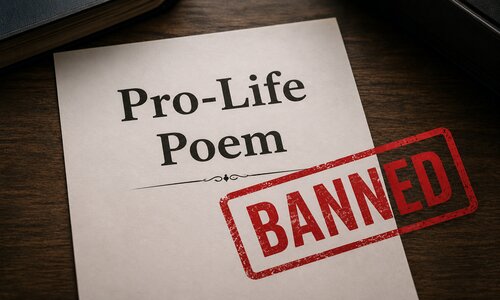
That is the shocking controversy now erupting out of Colorado, where a student at Drake Middle School was reportedly barred from reading a pro-life slam poem during a classroom assignment despite school staff admitting it met all academic requirements.
According to reports highlighted by Libs of TikTok and Not the Bee, the student's poem included Bible verses, references to Dr. Seuss, and statistics regarding abortion. School officials reportedly acknowledged the assignment satisfied the class requirements, yet refused to allow the girl to present it aloud because it was deemed "politically charged" and potentially harmful to the "safety" of other students.
Think about how absurd that is for a moment.
A child expressing support for unborn life was treated as if she posed some kind of threat to the classroom environment.
Reports also claim the teacher initially attempted to remove the girl from class during the presentations altogether before backing down after pushback. Meanwhile, students allegedly had previously been permitted to give presentations touching on gun control, LGBT rights, immigration, and even material mocking Jesus and Christianity.
Apparently, controversy is welcome in the classroom -- but only when it flows in one ideological direction.
That is not education. That is indoctrination disguised as tolerance.
What makes this story even more powerful is the deeply personal reason the student cared about the issue in the first place. According to public comments from the family, the girl's grandmother became pregnant at just 14 years old and chose life. That difficult decision ultimately led to generations of family members who would never have existed otherwise.
"There's hope in hard situations," the student's mother reportedly shared. "There's purpose in pain. Good things come out of situations that seem bleak. My family is proof of that."
That should have sparked thoughtful conversation and compassion.
Instead, it was reportedly censored.
This controversy is also unfolding within a broader climate in Colorado that many Christians and conservatives increasingly view as openly hostile toward traditional biblical values. Under Governor Jared Polis, the state has repeatedly found itself at the center of major religious liberty battles involving Christian business owners, churches, parental rights disputes, and aggressive LGBT-related policies.
The state became nationally known through the legal ordeal involving Christian cake artist Jack Phillips, who spent years battling government pressure over his refusal to create cakes celebrating same-sex weddings and gender transitions. More recently, school districts throughout Colorado have faced backlash and lawsuits over transgender policies involving bathrooms, pronouns, and overnight student accommodations.
To many families, this latest incident at Drake Middle School does not feel isolated. It feels like another example of a system increasingly comfortable marginalizing Christian and conservative viewpoints while aggressively promoting progressive ideology.
And perhaps the most alarming part is the language used to justify it all.
The student's poem was reportedly considered "unsafe."
Unsafe has become one of the most dangerous words in modern American culture because it is now routinely weaponized to silence disagreement. Increasingly, people are told they have a right not merely to physical safety, but to emotional insulation from opinions they dislike.
But freedom does not work that way.
A free society requires the ability to hear opposing viewpoints -- especially peaceful viewpoints expressed respectfully. If public schools begin treating traditional Christian beliefs as inherently harmful, they are not preparing students for democracy. They are preparing them for ideological conformity.
And what lesson are young Christians learning from this?
They are learning to stay quiet.
They are learning that expressing biblical convictions publicly may result in humiliation, censorship, or exclusion. They are learning that progressive activism is celebrated as courageous while conservative faith is portrayed as dangerous.
That is a devastating message to send to children.
Ironically, the adults in this story may have accomplished the exact opposite of what they intended. By attempting to silence this young girl, they amplified her voice across the nation. Millions of Americans are now discussing a poem they were never supposed to hear.
And perhaps that is the deeper lesson here.
Truth does not disappear simply because institutions try to suppress it.
This 13-year-old girl displayed more courage than many elected officials, educators, and cultural leaders. She stood calmly for what she believed, rooted in faith, family history, and conviction -- even when adults allegedly told her those beliefs were too offensive to be spoken aloud.
That should concern every American who still believes free speech belongs to everyone -- not just those with approved opinions.