
ChatGPT Wants Access To Your Finances — What Could Go Wrong?
 By PNW Staff May 21, 2026
Share this article:
The warnings about artificial intelligence have often focused on dramatic scenarios: robots replacing workers, deepfakes disrupting elections, or autonomous systems making dangerous decisions without human oversight. But one of the most significant and potentially invasive developments may be unfolding much more quietly -- through convenience.
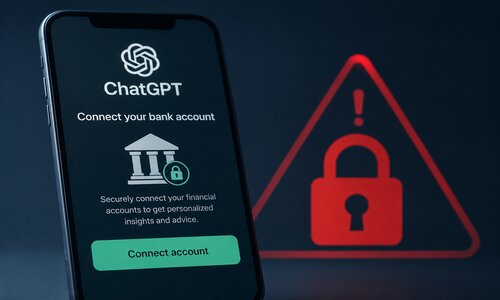
Now, according to reports surrounding a new rollout from OpenAI, select users are being given the ability to link their bank accounts directly to OpenAI's chatbot platform, allowing the AI to analyze financial information such as balances, spending habits, investments, debts, and liabilities across thousands of financial institutions.
The pitch is predictable: smarter budgeting, personalized recommendations, automated financial insights, and a more "helpful" digital assistant.
But beneath the sleek marketing lies a deeply unsettling question:
How much of your life should artificial intelligence really know?
For years, people have already handed over enormous amounts of personal data to technology companies. Smartphones know where we travel. Search engines know what we think about. Social media knows our political opinions, fears, habits, and relationships. Email providers scan inboxes for ad targeting and algorithms track nearly every click online.
Now the next frontier appears to be financial surveillance.
And unlike social media posts or browsing habits, financial records expose the deepest realities of a person's life.
Your bank account can reveal your medical struggles, marriage problems, addictions, political donations, religious giving, travel patterns, income level, debts, investments, and vulnerabilities. It can show when you are desperate, when you are prosperous, when you are fearful, and when you are under pressure.
That is an astonishing amount of power to place into the hands of an AI-driven ecosystem.
Supporters argue that secure third-party integrations already exist throughout the financial industry. Budgeting apps, investment platforms, and tax software have long connected to banking institutions. But AI changes the equation dramatically because it is not merely storing data -- it is interpreting it, learning from it, and building increasingly detailed behavioral profiles around it.
That distinction matters.
Artificial intelligence systems thrive on data. The more intimate the information, the more powerful the predictive capabilities become. An AI that understands your financial behavior can potentially anticipate your stress levels, purchasing impulses, future needs, ideological preferences, or even emotional states.
Imagine a system that knows when you are financially vulnerable and can tailor advertisements, suggestions, or recommendations accordingly. Imagine AI-driven financial nudges steering users toward certain products, investments, or services based not only on need, but on psychological susceptibility.
This is where the issue moves far beyond convenience and enters dangerous territory.
The concern is not merely hacking -- though cybersecurity risks alone should alarm people. Major corporations, governments, hospitals, and financial institutions have all suffered data breaches despite claiming strong protections. Consumers are repeatedly told systems are "secure" until they suddenly are not.
The larger concern is what happens when AI systems become permanently intertwined with the infrastructure of daily life.
Today the system offers budgeting advice.
Tomorrow it may determine creditworthiness.
Next it could influence insurance rates, lending decisions, employment screenings, or government compliance systems.
History shows that technologies introduced for convenience often evolve into systems of dependence. Social media began as harmless connection. Smartphones promised productivity. Digital payment systems simplified commerce. Yet over time, each became deeply embedded into the structure of society in ways few originally anticipated.
Financial AI integration may follow the same path.
What happens when people become accustomed to allowing AI to monitor every transaction? What happens when banks, governments, or corporations begin expecting users to participate in these ecosystems? Could refusing AI integration someday become suspicious, inconvenient, or even economically limiting?
Those questions may sound extreme today. But many developments that seemed unthinkable a decade ago are now routine.
There is also another issue that deserves far more public attention: data permanence.
Even when companies promise information will not directly train AI models, the reality is that digital information rarely disappears completely. Data can be copied, retained, subpoenaed, leaked, sold, or repurposed years later under changing policies or corporate ownership structures.
Consumers are essentially being asked to trust that future executives, future governments, future AI systems, and future cybersecurity environments will always handle this data responsibly.
That is an enormous leap of faith.
And once privacy is surrendered, reclaiming it is almost impossible.
Many Americans are already uneasy about the growing merger between technology, finance, and centralized digital systems. Concerns surrounding digital IDs, central bank digital currencies, biometric authentication, and algorithmic monitoring continue to intensify worldwide. The idea of AI gaining direct visibility into personal finances only deepens those fears.
To be clear, artificial intelligence itself is not inherently evil. Used wisely, it can improve efficiency, assist with research, streamline financial planning, and help consumers make informed decisions.
But wisdom requires boundaries.
Just because technology can access something does not mean it should.
In the race toward an AI-driven future, society is moving faster than its ethical safeguards. Consumers are being encouraged to surrender highly sensitive information before long-term consequences are fully understood. Convenience is once again becoming the bait used to normalize deeper surveillance and dependency.
And history suggests that once the public becomes comfortable with a new technological norm, there is rarely any going back.
The danger is not simply that AI may know too much.
The danger is that humanity may slowly become comfortable with living in a world where nothing remains private at all.