10 Reasons Socialism Sounds Christian - Until You Look More Closely
 By PNW Staff September 08, 2026
Share this article:
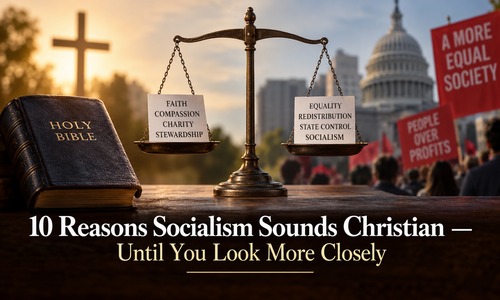
At first glance, socialism can sound remarkably compatible with Christianity.
Care for the poor. Reduce suffering. Challenge exploitation. Make sure people have food, housing and medical care. Christians hardly need to be convinced that these things matter. Scripture repeatedly commands God's people to care for widows, orphans, strangers and those in genuine need.
That helps explain why some Christians see socialist ideas as a natural extension of biblical compassion.
But sharing a concern does not necessarily mean sharing the same solution. Socialism is generally understood as an economic system involving public or social ownership or control of major productive resources. Christianity is not an economic system at all. It is a theological worldview that addresses human nature, property, work, generosity, responsibility and the proper use of wealth.
When those ideas are compared, several important tensions emerge.
1. Biblical Giving Comes From The Heart
One of the clearest New Testament passages about giving appears in 2 Corinthians 9:7, where Paul tells believers that giving should come from what someone has decided in his heart, "not reluctantly or under compulsion."
That doesn't answer every question about taxation or government assistance. Governments routinely collect taxes for purposes citizens may or may not personally support.
But it establishes something important about Christian charity: God isn't interested only in transferring resources from someone who has them to someone who needs them. He is also interested in generosity occurring in the heart of the giver.
2. Acts 2 Was Radical Generosity — But Was It Socialism?
Acts 2 is frequently raised in discussions of Christianity and socialism because believers "had everything in common" and sold possessions to help those in need.
Yet Acts 5 provides an important qualification.
When Ananias sold property and lied about the proceeds, Peter told him that the property belonged to him before it was sold and that the money remained at his disposal afterward. His sin was deception, not refusing to surrender everything he owned.
The picture in Acts is therefore one of extraordinary voluntary sharing within the church, rather than government abolition of private ownership.
3. Christianity Locates The Problem Deeper Than Economic Class
Socialist traditions have often understood society through tensions between economic classes and ownership of productive resources.
Christianity certainly recognizes economic oppression. Scripture repeatedly condemns exploitation of the poor.
But Christianity's diagnosis goes deeper: the fundamental human problem is sin.
Rich people can be greedy. Employers can exploit workers. But workers, politicians, bureaucrats and revolutionaries are fallen human beings as well.
Changing who controls wealth does not change human nature.
4. Scripture Assumes Private Property Exists
The commandments against stealing and coveting make little sense without some concept of legitimate possession.
Likewise, throughout Scripture people own homes, land, businesses and possessions. The Bible repeatedly regulates how property should be acquired and used rather than simply abolishing ownership.
Acts itself continues referring to Christians who owned homes even after describing the Jerusalem believers' remarkable sharing of possessions.
5. Ownership Comes With Accountability
Yet biblical ownership is very different from saying, "It's mine, so I can do whatever I want with it."
Christianity introduces the concept of stewardship.
Everything ultimately belongs to God. Wealth, abilities, opportunities and possessions are entrusted to human beings, who remain accountable for how they use them.
The biblical owner therefore has both property and responsibility.
6. Compassion And Personal Responsibility Exist Together
Scripture contains strong commands to provide for people in need, but it also emphasizes work and responsibility.
Paul famously distinguishes someone unwilling to work from someone unable to do so. Elsewhere, Scripture gives special attention to widows, orphans and others genuinely unable to provide for themselves.
Biblical compassion therefore involves more than simply transferring resources. It also raises questions about responsibility, restoration and helping people become capable of providing for themselves when possible.
7. Government Assistance And Christian Charity Aren't Identical
A government welfare program can provide real food, housing or medical assistance to someone who desperately needs it. That material benefit shouldn't be dismissed simply because government provided it.
But it also shouldn't automatically be described as Christian charity.
Biblical charity involves love, sacrifice, obedience and often personal relationship. Paul repeatedly describes generosity as something believers consciously choose to practice.
Government can redistribute resources. It cannot require the spiritual transformation Christianity associates with generosity.
8. There Is A Risk Of Outsourcing Love Of Neighbor
This presents a challenge that goes beyond economics.
Jesus commanded people to love their neighbors. The early church fed people, cared for widows, practiced hospitality and shared possessions.
Modern societies can transfer many of those responsibilities to institutions.
That may provide important assistance, but it raises a distinctly Christian question: Can believers begin assuming they have fulfilled their responsibility toward the poor simply because government programs exist?
Christian charity historically involves more than funding. It involves people.
9. Biblical Justice Doesn't Necessarily Mean Identical Outcomes
Scripture strongly condemns dishonest business practices, exploitation, favoritism and withholding wages.
But economic inequality itself is not consistently treated as synonymous with injustice.
People possess different abilities, opportunities and resources. The biblical emphasis is repeatedly on justice, honest dealing, generosity and faithfulness with what someone possesses.
That differs from the idea that justice necessarily requires equal economic outcomes.
10. Capitalism Isn't Christianity Either
This may be the most important qualification.
Rejecting a biblical identification with socialism does not establish capitalism as Christianity's economic equivalent.
Scripture has plenty to say against greed, materialism, exploitation and indifference toward suffering. James delivers a severe warning to wealthy people who withheld wages from their workers. Christianity offers no theological defense for getting rich through dishonesty or treating profit as life's highest purpose.
Markets may facilitate ownership, investment, entrepreneurship and exchange. They do not make those participating in them righteous.
The Biblical Alternative Is Stewardship
Perhaps the biggest problem with trying to squeeze Christianity into modern economic categories is that Christianity makes demands neither socialism nor capitalism can fully capture.
The Christian cannot simply say, "The government should take care of the poor."
But neither can he say, "It's my money, and nobody can tell me what to do with it."
Biblical stewardship presents a different standard: What we possess may legitimately belong to us in an earthly sense, yet ultimately everything belongs to God.
That means the Christian questions surrounding wealth go far beyond who owns the means of production or what tax rate should apply. They include how wealth was obtained, how workers were treated, how families were provided for, whether the vulnerable were ignored, whether generosity was practiced and whether possessions became an idol.
Socialism can redistribute wealth. Capitalism can create wealth. Christianity asks a different and ultimately deeper question:
What will we do with whatever God has placed in our hands?